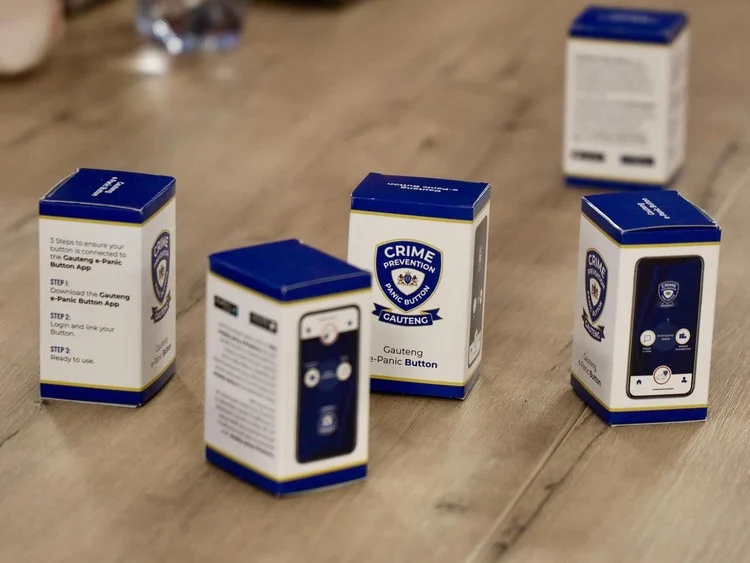
There are more questions than answers about the Gauteng government’s plan to roll out panic buttons. Photo from Gauteng government’s Instagram page (fair dealing)
- In December 2024, the Gauteng government said more than 80,000 physical e-Panic Buttons had been distributed.
- Less than three months later, Premier Panyaza Lesufi said the number was 2,000.
- The department reached just 5% of its 40,000 target for 2024/25, and said the rollout would not continue because of budget constraints.
- Neither the Gauteng government nor the developer of the e-Panic system (also responsible for providing the panic button system) responded to our questions despite being given several days to do so.
In December 2024, the Gauteng government announced that it had handed out more than 80,000 physical panic buttons. But according to Premier Panyaza Lesufi and its own annual report, it had actually only handed out 2,000.
The e-Panic Button comes in two forms: a smartphone app and a separate physical device. Both are supposed to let residents call for help in an emergency.
In September, we reported that the app’s unsecured database exposed users’ crime reports and locations.
This article is about the physical buttons. They matter because not everyone has a smartphone. The province has marketed the buttons especially to elderly residents.
500,000 buttons promised
On 22 May 2024, the Department of e-Government announced that 100,000 physical panic buttons would be distributed to the public.
Less than two months later, the promise had grown fivefold. A media advisory on 17 July 2024 said MEC Bonginkosi Dhlamini (IFP) would hand out physical panic buttons to elderly residents in Kagiso for Mandela Day, and that more than 500,000 panic buttons would be distributed over the next three months.
The 80,000 claim
By December, the province started claiming success. On 2 December 2024, the Office of the Premier said more than 80,000 physical e-Panic Buttons had been distributed across Gauteng. It gave this as an example of the province’s fight against crime and gender-based violence.
Then the real number
On 24 February 2025, in his State of the Province Address, Lesufi told the legislature that 2,000 panic buttons had been distributed. More than 101,000 people had downloaded the app at the time.
So in less than three months, 80,000 buttons became 2,000. Did they explode? Were they stolen? Taken from residents by aliens? We are not sure.
The department’s 2024/25 annual report backs up the premier. It says 2,000 physical buttons were deployed in the financial year ending 31 March 2025. Now the target was 40,000.
“The target was not achieved because of budget constraints. During budget adjustment the department had requested additional funds but the request was not successful,” the report states.
The report then says the project would not continue, also because of budget constraints. Strangely, the original tender included a requirement to provide 100,000 physical panic buttons.
We sent questions to MEC Dhlamini, head of department Masabata Mutlaneng and their various spokespeople. We also sent the questions to Theuno de Bruin of Evolve VAS, the company that won the tender for the e-Panic system. We gave them more days to respond.
A GroundUp staff member also phoned Nhlanhla Cebekhulu, Chief Director of Communications for the e-Government department. He promised we’d receive a response.
We also then received an email from Evolve’s lawyers asking us to send all correspondence for Evolve to them, so we extend the deadline.
We’ve received no response to our questions from anyone.
© 2026 GroundUp. This article is published under the GroundUp Republication Licence Version 1.0. Email [email protected] to request permission to republish.