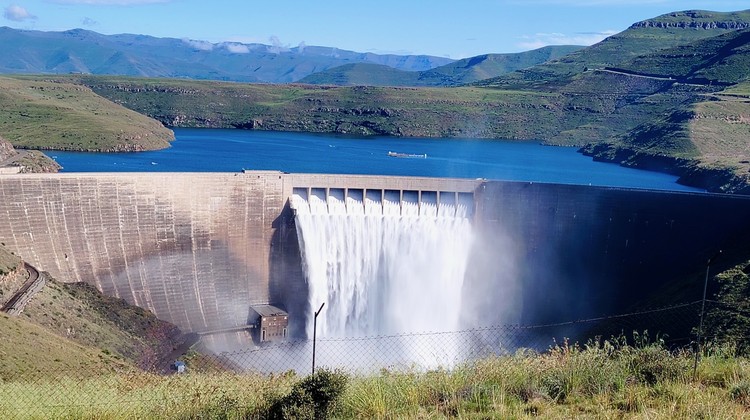
The Katse Dam, which provides water to South Africa, is one of several dams whose construction saw extensive loss of resources for several Lesotho communities. Photo: Sechaba Mokhethi
- The high court in Lesotho has ordered the Lesotho Highlands Development Authority to pay nearly M90-million to 20 community associations within 90 days.
- The compensation is for losses linked to the Katse and Mohale dams, which supply water to South Africa, after more than 13 years of delays.
- The settlement follows a landmark ruling involving over 600 villagers in Bobete for losses of grazing land, river ecosystems and natural resources, including firewood, fish, wild vegetables and medicinal plants.
- We reviewed some of the many legal battles around compensation from the LHDA.
Communities in Lesotho have won a major victory in their longstanding battle for compensation for losses caused by the construction of dams for the Lesotho Highlands Water Project (LHWP), which provides water to South Africa.
After 13 years of delays in paying compensation to communities affected by LHWP Phase 1, the high court on 20 October ordered the Lesotho Highlands Development Authority (LHDA) to pay M89.9-million (M1 = R1) within 90 days.
The settlement, made a court order by Acting Justice Tšebang Putsoane, will see payments to 20 community associations, mostly from Thaba-Tseka, of between M16.2-million and M848,000. The total amount has increased by 8% since 2013, when LHDA stopped payment of a second tranche of compensation.
An ombudsman report released in March said Phase 1 arrears stood at more than M142-million at the end of 2025.
The 20 associations and communities relied on a landmark judgment by the Court of Appeal which ruled in favour of a group of 600 villagers under the U Khopo Maliba-Matšo Society based in Bobete in Thaba-Tseka district, who faced similar compensation challenges against LHDA.
Landmark ruling
The U Khopo Maliba-Matšo Society launched high court proceedings against LHDA in 2020, demanding the second tranche of compensation.
The LHDA had paid the first tranche in 2003 and 2004 to communities and associations formed under its guidance to receive communal compensation. Communities lost grazing land, riverine ecosystems and their sources of firewood, fish, wild vegetables and medicinal plants.
The second tranche of compensation required a ten-year review in 2013. However, the LHDA stopped the payments that year, later citing a consultant’s monitoring report that claimed there was no evidence of compensable losses.
On 19 March 2025, the high court ordered the LHDA to compensate Bobete villagers whose livelihoods were disrupted by the construction of Katse Dam.
On 7 November 2025, the Court of Appeal dismissed LHDA’s appeal and ordered it to pay compensation owed since 2013 to the Bobete villagers. The court found that the LHDA’s decision to stop paying without consulting the community procedurally unfair and unlawful. It gave LHDA 90 days to make payment.
In February, GroundUp reported that LHDA had missed that deadline.
Advocate Rapapa Sepiriti, representing the associations and communities, told GroundUp the LHDA eventually paid M8.2-million to U Khopo Maliba-Matšo Society. The group had received about M2.7-million in 2003.
Having learned of the judgment, the associations wrote to LHDA in November and December 2025 to initiate negotiations. The LHDA “pleaded with us to give them more time to consider our claim”, said Sepiriti.
In her founding affidavit, Malesaoana Pitso of Ha Khoanyane, secretary-general of Kamohelo Khoanyane Association, said the associations waited for more than six months without a response from LHDA. They then launched their case in June 2026.
The LHDA then opened negotiations to settle the matter out of court. They agreed on a payment of M89.9-million.
Constitutional challenge rejected
In July 2025, more than 3,000 people and 889 businesses approached the Constitutional Court, arguing that the LHDA denied them fair compensation for land taken since the 1980s.
Some families allegedly received as little as 78 cents per square metre for their land, with properties expropriated years before compensation was even calculated.
The applicants from Mokhotlong and Thaba-Tseka alleged that community members were subjected to arrest, detention and torture, and that a promised community development fund was never established.
In response, the LHDA sought dismissal of the case, saying the Mokhotlong Business Forum Development Trust and the Community Resources Development Trust, were new entities that lacked the legal status to initiate a lawsuit against a project launched nearly 40 years before.
The LHDA chief executive officer Tente Tente said the applicants’ claims were riddled with legal and factual flaws. He said compensation mechanisms already existed and had been implemented under Lesotho’s laws and the LHDA’s compensation policies, dating back decades.
Tente argued that the applicants’ petition to the court was irregular.
On allegations of unlawful arrest, torture and prosecution, Tente said these were criminal matters and could not be bundled into the case about compensation and infrastructure development.
In May 2026, the Constitutional Court agreed with LHDA and held that Lesotho’s Constitution allowed the court to decline litigation where adequate alternative remedies already exist.
The court found that the LHDA Act, the Land Act and the Lesotho Highlands Water Project compensation regulations already provided mechanisms for compensation.
“Since their complaint is solely about non-payment, delayed payment, and underpayment of compensation, the question is whether the dispute can be resolved and determined on non-constitutional grounds,” the judgment noted.
“The applicants, therefore, have adequate means of redress in the high court and the magistrates’ court for the alleged violation of their human rights.”
Outstanding compensation
In September 2025, 18 rural communities filed a complaint against the African Development Bank (AfDB) over Phase 2 of the water project.
The AfDB has provided a R1.3-billion loan to the Trans-Caledon Tunnel Authority with a guarantee from the South African government.
About 1,600 villagers, backed by human rights groups Seinoli Legal Centre and Accountability Counsel, claimed compensation was inadequate and delayed. They alleged unsatisfactory relocations, damaged homes and loss of farmland, among other harms. They also accused LHDA of failing to consult properly and ignoring their grievances.
AfDB issued a detailed response, saying it was satisfied with the project’s implementation but acknowledging challenges and calling for continued improvements. It said LHDA had complied with the bank’s policy requirements in implementing the project.
By September 2025, the bank said 4,236 of 4,574 approved household and individual assets had been compensated. However, it said some payments remained outstanding because of issues with documentation, such as missing identity documents and disputes over family ownership.
“LHDA continues to support affected persons to obtain necessary documentation through working with government departments to issue required documentation and resolve disputes within families,” the bank said.