San Jose, California – President Cyril Ramaphosa says South Africa must move beyond being a consumer of artificial intelligence (AI) and digital technologies developed elsewhere and build its own technological capabilities, enterprises and intellectual property.
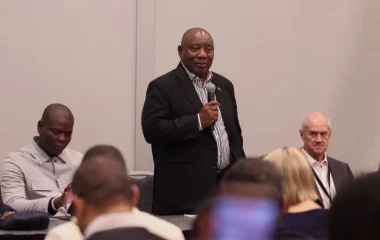
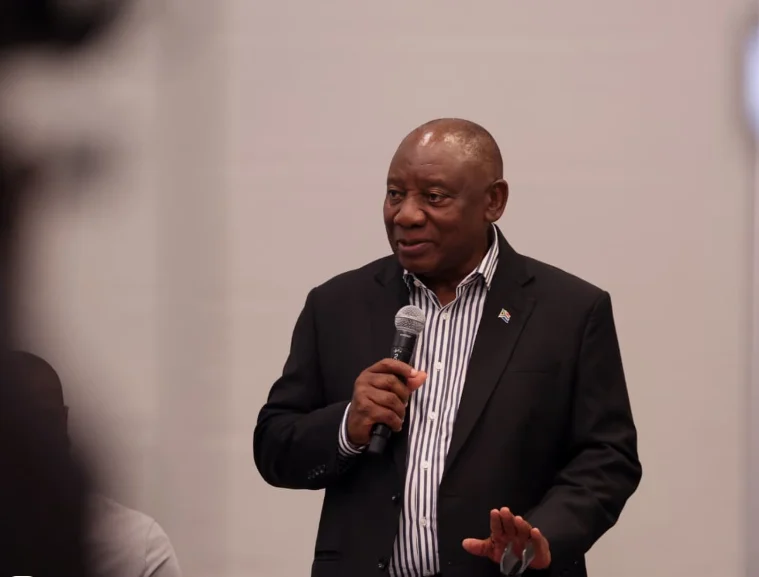
Addressing members of the high-level South African delegation ahead of its programme of engagements in Silicon Valley, California, on Sunday, the President said the country could not afford to be left behind as technological developments reshape economies and societies.
“We cannot afford to become merely consumers of these technologies that are controlled elsewhere, particularly in the northern hemisphere; we want to become active participants in shaping this new technological age. That is why we are here,” President Ramaphosa said.
The President said the working visit was not simply about learning from the world’s leading technology companies, but about identifying what South Africa could develop at home and establishing partnerships that would strengthen its participation in the global digital economy.
“We have not come to Silicon Valley merely to see the future. We have come to help shape South Africa’s place in that future,” he said.
The delegation’s programme includes engagements with leading technology companies, investors, researchers and academic institutions, as well as demonstrations and knowledge exchanges on frontier AI, robotics, data infrastructure, cloud computing and digital innovation.
President Ramaphosa said South Africa had important strengths on which to build, including world-class universities and research institutions, a sophisticated financial services sector, a growing technology industry and established digital infrastructure.
He also pointed to the country’s talent and the investments already made by major international technology companies, including Microsoft, Amazon Web Services and Google, which have established data centres and cloud computing operations in South Africa.
“We must move from being a location for digital infrastructure to becoming a centre of digital innovation; our ambition must be to make South Africa not only a gateway to Africa’s digital economy, but one of the engines that are driving its growth,” he said.
The President said South Africa should seek to develop its own AI enterprises, applications and intellectual property, while creating opportunities for local innovators to develop solutions that could be used across the continent and beyond.
He identified investment in data centres, advanced computing, digital infrastructure, research and development, and technology-driven industries as key areas for cooperation.
The visit also provides an opportunity to understand how venture capital and other forms of investment can support innovative businesses, and how government, universities and the private sector can work together to turn ideas into commercially viable enterprises.
Innovation and AI governance
President Ramaphosa said South Africa should learn from Silicon Valley’s experience without simply attempting to replicate its model, noting that the country’s development needs and circumstances are different.
Instead, he called for an innovation ecosystem that supports entrepreneurs in townships and rural areas, as well as those in major cities, and creates opportunities for small businesses and emerging innovators alongside established companies.
He also highlighted the importance of responsible AI governance, saying technological advancement raised questions about ethics, privacy, security, human dignity and the concentration of technological power.
The President said South Africa must embrace innovation while ensuring that AI remained subject to human oversight and democratic accountability.
He further emphasised the need to create an enabling environment for investment by improving energy reliability and affordability, expanding digital connectivity, strengthening skills, providing policy certainty and making it easier to establish and grow businesses.
Government must also become an early and effective adopter of AI to improve the quality, efficiency and accessibility of public services.
The President said the pace of technological change requires government to work differently and remove unnecessary regulatory and administrative obstacles that could discourage investment and frustrate innovation.
“We cannot afford to move at yesterday’s pace in a world that is changing at tomorrow’s speed. The pace of technological change will not wait for the pace of our bureaucracy,” the President said.
He said the success of the visit would not be measured by the number of meetings attended, or companies visited, but by the partnerships, investment opportunities and practical initiatives that emerged.
READ | Ramaphosa urges youth to shape future of technology
Practical initiatives
The President proposed that within 90 days of the delegation’s return, a focused set of practical initiatives should be identified for implementation.
These should include investment opportunities, research and skills partnerships and the application of AI to improve public services and strengthen the economy.
He said the country needed a coordinated national effort involving government, business, universities and research institutions to ensure that South Africa became an active participant in shaping the future of artificial intelligence. – SAnews.gov.za
Source: Original report at SAnews.gov.za.