By Tembile Sgqolana, Health-e News
For 91-year-old Nowenzile Mcwayi, collecting medication for diabetes and hypertension has meant waking up before sunrise, travelling long distances and spending almost an entire day at the clinic.
The journey from her home in Sigubudweni village to Baziya clinic covers about 40km. She needs R50 for transport, as well as money for food while waiting in long queues.
“I must wake up at 4am and leave home by 5am, and I only get back home at 3pm,” she says.
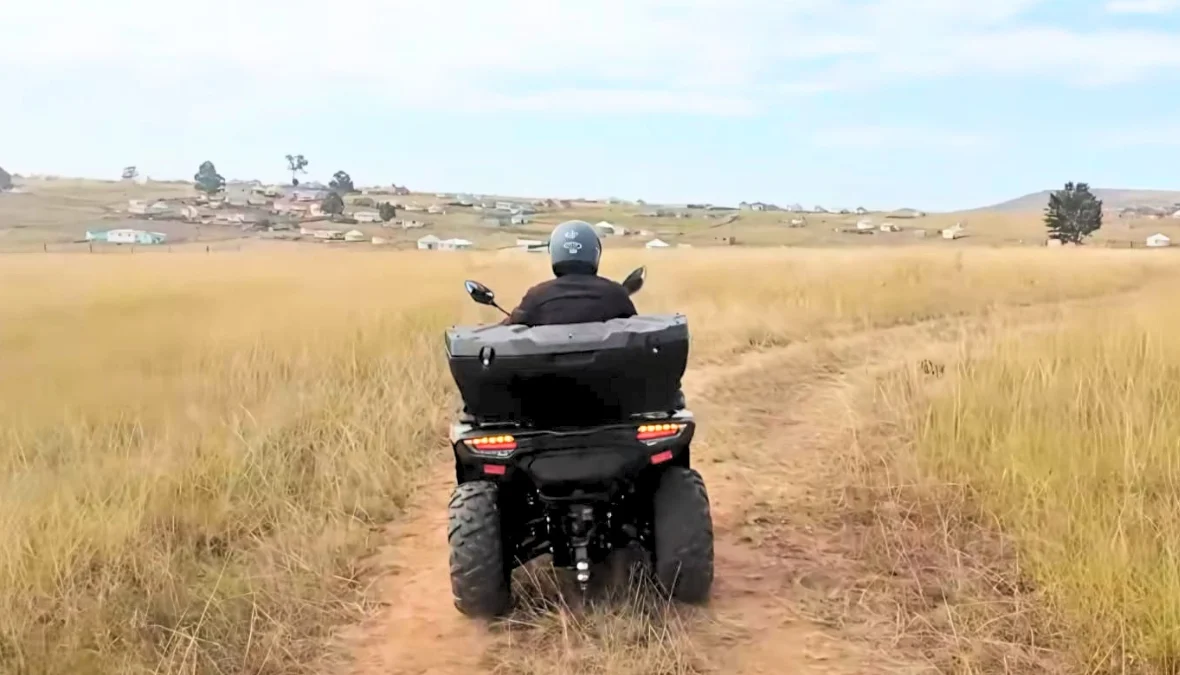
Now, a community-led initiative launched in early October, uses quad bikes to deliver chronic medication to patients in remote villages, offering relief for some patients like Mcwayi.
“Having all the treatment delivered at my home removes all the burden. It’s a great relief financially, emotionally and physically,” she says.
Long journey to collect medication
67-year-old Sadunana Gaqa, who lives with hypertension, says the cost and availability of transport made his monthly medication collection a challenge.
To avoid missing his collection date, Gaqa says he developed a routine of leaving home the day before to spend the night with relatives who live closer to the clinic.
His return journey cost about R50. Gaqa will now be one of the beneficiaries of the home delivery initiative.
Nkosikazi Nowilo II Joyi, executive director of the Nkosi Minenkulu Joyi Foundation (NMJF) says the organisation has encountered patients who struggle to afford transport, including people with disabilities and limited mobility.
“At times, people are forced to choose between buying food for their families and paying for transport to the clinic to collect their medication.”
Quad bikes deliver medication
The initiative by NMJF, supported by the Baziya Traditional Council, aims to improve access to medication for residents across 49 villages under the jurisdiction of Nkosi Minenkulu Joyi.
The royal house of Joyi’s Great Place has been approved as an external pick-up point under the national Central Chronic Medicines Dispensing and Distribution (CCMDD) programme, known as Dablapmeds, designed to make access to chronic medication more convenient for eligible patients.
Health-e News has previously reported on the programme.
Under the local Baziya initiative, two quad bike drivers now transport medication to some patients’ homes. The quad bikes are central to the operation because they can navigate rough roads and narrow rural paths that may be difficult for ordinary vehicles to access.
Phaphama Joyi, one of the two quad bike drivers, said: “Making these deliveries is not difficult as we are using the quad bikes, which make it easy to travel on the bad roads.”
According to Phaphama, the use of quad bikes do still carry risks, particularly on steep slopes and uneven terrain, where they can overturn. The team typically completes between six and 12 deliveries a day.
The foundation is also training locals to operate drones to track and monitor deliveries for security purposes. Joyi says the drone-tracking will be rolled out once the necessary drone pilot licence has been acquired.
Limited resources restrict deliveries
According to Joyi, the local clinic serves a population of about 20,000 people and has 1,774 active chronic medication patients registered. Some residents travel between 15km and 40km to collect their medication.
Despite the scale of the need, the foundation’s current delivery operation remains small. “We are currently delivering to 26 households serving 96 patients in one administrative area of Baziya,” Joyi says.
The project has received more than R1.2-million in funding from the Small Enterprise Development and Finance Agency. Joyi says the foundation hopes to find corporate social investment partners and extend home deliveries to a thousand patients and eventually to neighbouring communities.
Eastern Cape Health MEC, Ntandokazi Capa says the initiative was designed to complement existing public healthcare services rather than replace clinics. “The clinic remains important for monitoring patients and ensuring that medicine is dispensed in accordance with the required medical protocols.”
Capa told Health-e News this was their first CCMDD initiative working with traditional leaders in the province.