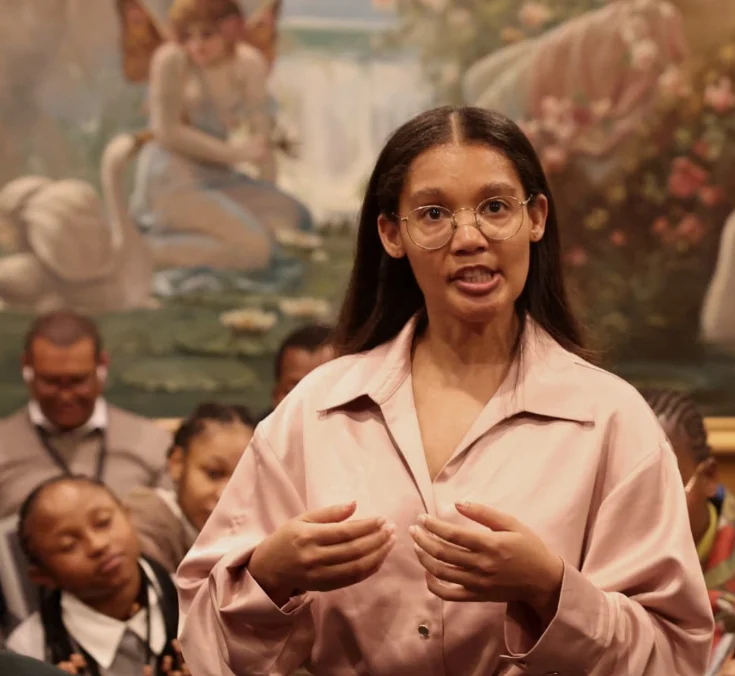
Silicon Valley, California – A South African mathematics teacher and doctoral student says her experience in Silicon Valley has strengthened her commitment to equipping young people with the knowledge and skills to navigate an increasingly artificial intelligence (AI)-driven world.
Speaking to SAnews, Anastasia Gordon, a PhD student at the Cape Peninsula University of Technology (CPUT), said the visit has broadened her understanding of how AI and technological innovation can be harnessed to advance social inclusion, promote equity and address challenges facing South Africa.
Gordon, whose research focuses on mathematics education and the use of AI and information and communication technology (ICT) to promote critical thinking in the classroom, was part of the student delegation accompanying President Cyril Ramaphosa during his engagements in California.
She said before travelling to Silicon Valley, she had been concerned about the potential impact of AI on unemployment, particularly against the backdrop of South Africa’s high unemployment rate and changing economic landscape.
However, the experience has shifted her perspective, particularly after hearing the President challenge students and researchers to develop expertise in AI and contribute to the country’s technological advancement.
“[Given] the changing landscape in South Africa and the high unemployment rate, it has been very concerning for me to think that AI can contribute to this unemployment. However, I am so grateful to be a part of this mission to Silicon Valley. It has really changed my perspective,” she told SAnews.
Gordon said she has come to appreciate that developing local expertise in AI is essential to ensuring that South Africans are not merely consumers of technology but can also shape its development and application.
“Listening to the President and looking at the task and challenge that he’s put in front of us, I can clearly see that being an expert in AI means that as a people, we won’t be controlled or exploited by AI,” she said.
As both a researcher and high school mathematics teacher, Gordon said she has taken the President’s challenge personally, particularly the responsibility to prepare learners for the opportunities and challenges presented by emerging technologies.
For Gordon, this responsibility extends beyond introducing learners to technology, but also to ensuring they develop the critical thinking skills needed to understand and engage with it.
“I take up this challenge personally, not only [in] research in mathematics education, but as a high school mathematics teacher to ensure that every day in the classroom, I do my best to, as the President put it, prepare [learners] for the challenges and navigate them [around] the closing door that AI can bring, and to also prepare them for the doors that will open,” she said.
The mission, as Gordon puts it, is more than technological advancement — it’s about ensuring that the benefits of innovation reach all South Africans.
“It is an act of the pursuit of social justice for us as South Africans,” she said.
The delegation visited Stanford University and Sacramento State University, where Gordon said she gained valuable insights into how institutions are exploring the application of AI and robotics to promote equity and social inclusion.
At Stanford University, President Ramaphosa and the South African delegation toured the university’s Robotics Lab, led by Professor Allison Okamura, a Professor of Engineering.
The visit included demonstrations of robotic systems developed by the university’s mechanical engineering team, including lightweight robotic arms guided by camera technology to perform tasks with greater autonomy.
The delegation was also introduced to student-led research, exploring how humanoid robots can assist older people with everyday household activities, such as retrieving items.
The demonstrations highlighted the potential of robotics and AI to improve everyday living, while underscoring the importance of human-centred design and safety in developing technologies that work alongside people.
Gordon said the visits demonstrated how technological innovation can be used to address social challenges and create more inclusive environments.
She particularly reflected on her experience at Sacramento State University, where she observed the institution’s approach to equity and inclusion, including its cultural activities and the use of AI.
“It was a profound experience that I will take back to South Africa to ensure that in my space and in my circle as a researcher in mathematics education, that I do the same,” she said.
Gordon said she hoped to translate the lessons from Silicon Valley into practical interventions in her own academic and teaching environments, while playing a role to help South African learners to be better prepared to participate in and contribute to the evolving digital economy. – SAnews.gov.za
Source: Original report at SAnews.gov.za.