Radio remains one of South Africa’s most influential and accessible forms of media, playing a critical role in strengthening democracy, preserving cultural identity and giving communities a platform to tell their stories.
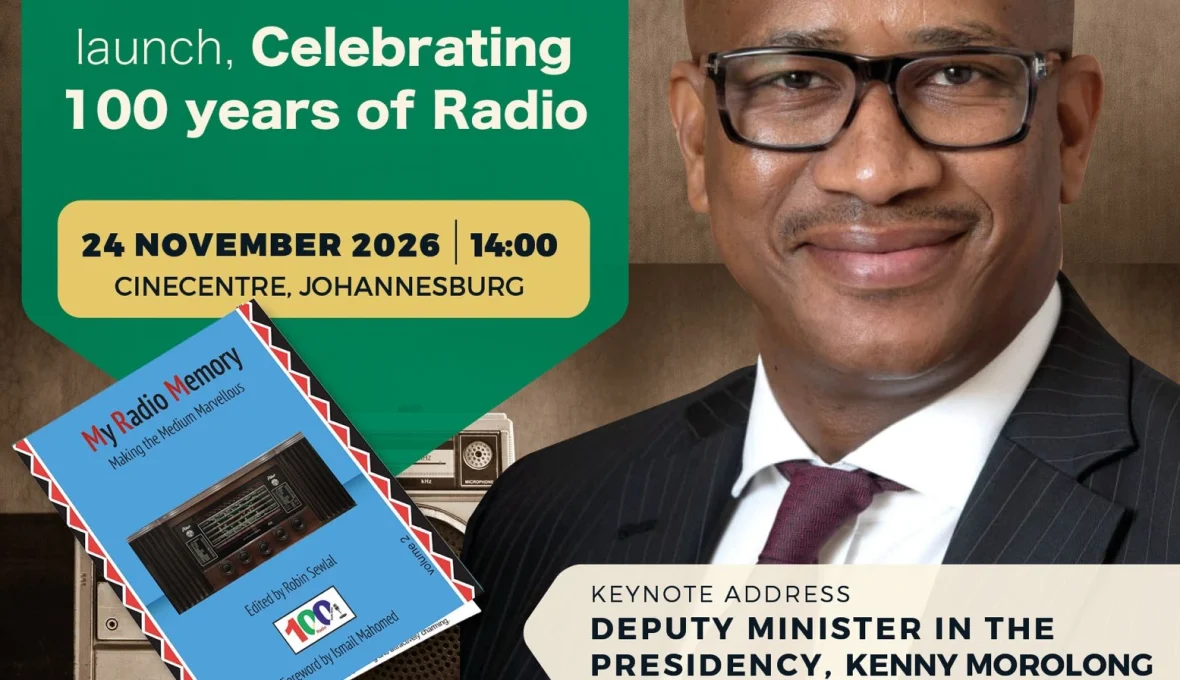
This according to Deputy Minister in the Presidency, Kenny Morolong, who delivered the keynote address at the launch of the second volume of the My Radio Memory: Making the Medium Marvellous book series.
Morolong described the publication as a vital contribution to documenting more than a century of radio broadcasting in South Africa.
“The second volume of this milestone series marks a significant contribution to documenting over 100 years of radio in South Africa.
“Featuring well over 100 contributions from some of the most influential and knowledgeable people in radio, including presenters, announcers and sports commentators, while also capturing the voice of leaders and managers in the industry, this publication captures an important part of our country’s social, cultural and media history,” the Deputy Minister said.
He added that the book is a “national treasure” documenting the evolution of radio and will serve as an important record of the people, experiences and milestones that have shaped South African radio over the past century.
Beyond a century of broadcasting
Morolong highlighted the historical significance of radio, tracing its beginnings to the first experimental broadcast at the Railway Headquarters in Johannesburg on 18 December 1923.
Regular radio broadcasting in South Africa began on the evening of 1 July 1924 at 9pm, marked by the chimes of the clock at the old Johannesburg Post Office.
He said radio’s evolution reflects South Africa’s own political and social journey, particularly its role during apartheid and the country’s transition to democracy.
“The evolution of radio mirrors the South African story. During apartheid, the state-controlled SABC, including Radio Bantu services, served as a propaganda tool which reinforced ethnic divisions among Black South Africans through language specific stations.
“This was countered by underground stations like Radio Freedom which mobilized resistance by sharing banned information, inspiring youth, and fostering a broader anti-apartheid consciousness.
“While at home independent stations such as Radio Bop, Radio 702 and Capital Radio 604 broke the state-controlled South African Broadcasting Corporation (SABC) monopoly by operating from ‘homeland’ territories,” Morolong said.
He also pointed to the landmark Jabulani! Freedom of the Airwaves conference, held in August 1991 in Doorn, Netherlands, which recommended the establishment of a three-tier broadcasting system in South Africa namely, public service, community and commercial.
“From the late 1980s to 1994, radio and especially the SABC services helped create the conditions for our transition to democracy.
“Radio was often at the forefront of introducing previously banned leaders to mass audiences, it supported voter education in people’s own languages, and broadcast the 1994 elections, contributing to our miracle transition to democracy,” the Deputy Minister said.
Strengthening community media
The establishment of the Independent Communications Authority of South Africa (ICASA) in 2000 and the Media Development and Diversity Agency (MDDA) in 2003 further strengthened the country’s broadcasting and community media landscape.
Morolong highlighted the MDDA’s instrumental role in supporting community media, particularly through funding and infrastructure development.
“The MDDA’s continued support for community media and especially radio has seen this vibrant sector flourish. I have been privileged to have overseen the handover of several new studios to community radio stations this year.
“I can tell you that this sector is buzzing, it is expanding its reach and influence and forms an integral part of the community media landscape in this country,” he said.
The Deputy Minister emphasised that community radio stations continue to provide platforms for “previously marginalised voices, enabling communities to participate in discussions on service delivery, governance, human rights and elections”.
“By 2023, the MDDA had supported 586 community media projects, including 321 community broadcasting projects and 185 community print projects.
“This represents a significant contribution towards broadening media ownership, promoting diversity and ensuring that more South Africans have access to platforms through which they can tell their stories,” he stated.
Culture, accessibility and the digital future
Morolong attributed radio’s continued relevance to its accessibility, affordability and ability to communicate with audiences in languages they understand, while addressing issues affecting their daily lives.
“Radio remains one of South Africa’s most accessible, pervasive, and influential mass media, deeply intertwined with democracy, cultural expression and the shaping of social norms.
“About 33 million South Africans, or roughly 75 percent of people aged 15 and older listen to radio each week, according to Broadcast Research Council of South Africa Radio Audience Measurement data,” he noted.
The Deputy Minister emphasised that radio’s contribution extends beyond news and information, with the medium playing an important role in promoting indigenous languages, traditional music, oral storytelling and local customs.
The Deputy Minister also highlighted the growing influence of digital radio and podcasts, describing them as the next frontier in the evolution of broadcasting, and noted that these developments demonstrated how the medium continued to adapt to changing audience preferences and technology.
Morolong called for government, the broadcasting industry and committed individuals to work together to safeguard radio and the broader creative industry.
Furthermore, he highlighted government initiatives such as the Mzansi Golden Economy programme, which supports arts, culture and heritage as drivers of job creation, economic growth, cultural tourism and social cohesion.
About the publication
The My Radio Memory: Making the Medium Marvellous compilation was conceived by author Robin Sewlal to mark the 100th anniversary of radio in South Africa.
Sewlal has put together 100 reminiscences from various authors, academics and personalities, all giving freely of their thoughts on their radio experiences.
He told SAnews that the book does not belong to him, but it belongs to all who read it.
“It is for all who read it, it is for all who love radio, it’s for everybody,” Selwal said. – SAnews.gov.za
Source: Original report at SAnews.gov.za.