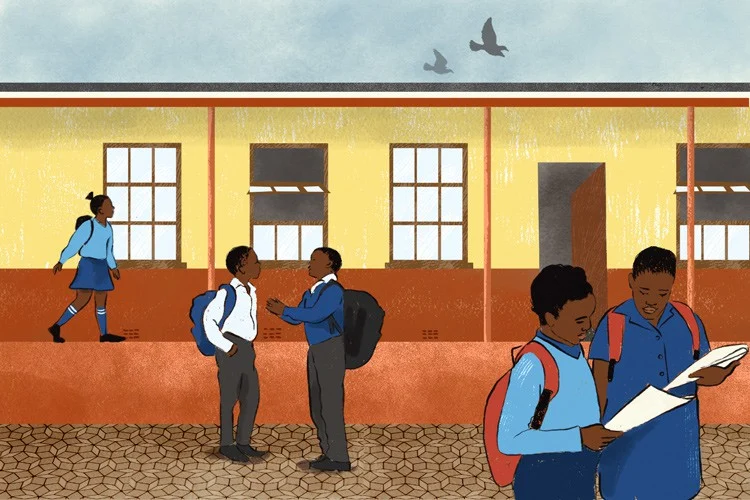
The Eastern Cape Department of Education will be hauled back to court for retaining 40% of every public school’s budget allocation in the province for 2026/7. Illustration: Lisa Nelson
More than three months after conceding that it had unlawfully withheld billions from schools since 2020, the Eastern Cape Department of Education will be hauled back to court for retaining 40% of every public school’s budget allocation in the province for 2026/27.
Eleven school governing bodies and the Makhanda Circle of Unity are returning to court to challenge the Eastern Cape Department of Education’s (ECDE) decision to withhold 40% of every public school’s allocation this financial year. The department’s figures put the amount at R1.1-billion.
In August, the department conceded that it had unlawfully withheld billions from schools since 2020, and the agreement was made an order of court. But the order left open whether it covered this financial year, 2026/27.
Now, the applicants want the Makhanda High Court to order the department to pay the schools the full amount by 31 March 2027.
Their application, filed on 3 November, will be heard on 3 December.
The respondents are the head of department and the MEC for education, the provincial government, the Minister of Basic Education, the Eastern Cape MEC for finance, the Minister of Finance and the national government.
Schools short-changed
At Tantyi Primary, a no-fee school in Makhanda, about 80% of the school’s parents are unemployed, the governing body’s treasurer said in an affidavit. Yet parents were asked to contribute toilet paper and copying paper because of a shortage of funds.
The school owes the municipality more than R57,000. Its municipal allocation is R47,600 for the year. The applicants say the department withheld R127,000 from the school.
Much of Tantyi’s upper storey is cordoned off because the roof has partially collapsed.
At Hoërskool PJ Olivier in Makhanda, a fee-charging school, 70% of learners do not pay fees, according to the governing body’s secretary.
The roofs leak, the hostel needs a boiler that the school cannot afford, and its municipal account is more than R1-million in arrears.
Where the money goes
At a meeting on 27 October with the head of the department and officials, the applicants’ lawyers were shown a budget of R2.75-billion for 1.58-million learners.
The department retained 40% of this – about R1.1-billion. According to the applicants’ account of the meeting, officials said the money pays for programmes the department runs centrally. About R469-million goes to the Learner Attainment Improvement Strategy; R151-million for school furniture; R129-million to bail out school municipal accounts; and R77-million for information technology.
The R469-million learner attainment budget includes matric boot camps and R35.6-million for an aviation programme delivered in partnership with a private flight school in Port Alfred.
ECDE spokesperson Mali Mtima said this programme was launched in 2025, with 25 learners enrolling each year from grade 10. The R35.6-million covers accommodation, catering, tuition, flight-school fees and uniforms.
There are currently 50 learners, meaning that this year’s budget comes to R712,000 per learner.
Much of the R56.6-million e-learning budget goes on tablets for matrics. GroundUp reported in August that more than a third of these devices in what is a R686-million project had not been returned by the end of 2025. None of the 12 schools GroundUp contacted were still running the programme in 2026.
Cecile van Schalkwyk, senior attorney at the Legal Resources Centre (LRC), which is representing the applicants, said the applicants recognised the potential value of programmes such as matric support. However, “the difficulty is that they are being funded using an allocation that is not meant for these projects,” she said.
Primary schools are losing 40% of their allocations to programmes that benefit matrics, she said.
What the court ordered in August
The Minister of Basic Education sets an annual funding target per learner for each of the five school quintiles. In August, the court ruled that a province may fund schools below the target only if it has a joint plan under the national funding norms showing that meeting the target is not financially feasible.
Van Schalkwyk said there was no such plan for 2026/27 (or any previous years).
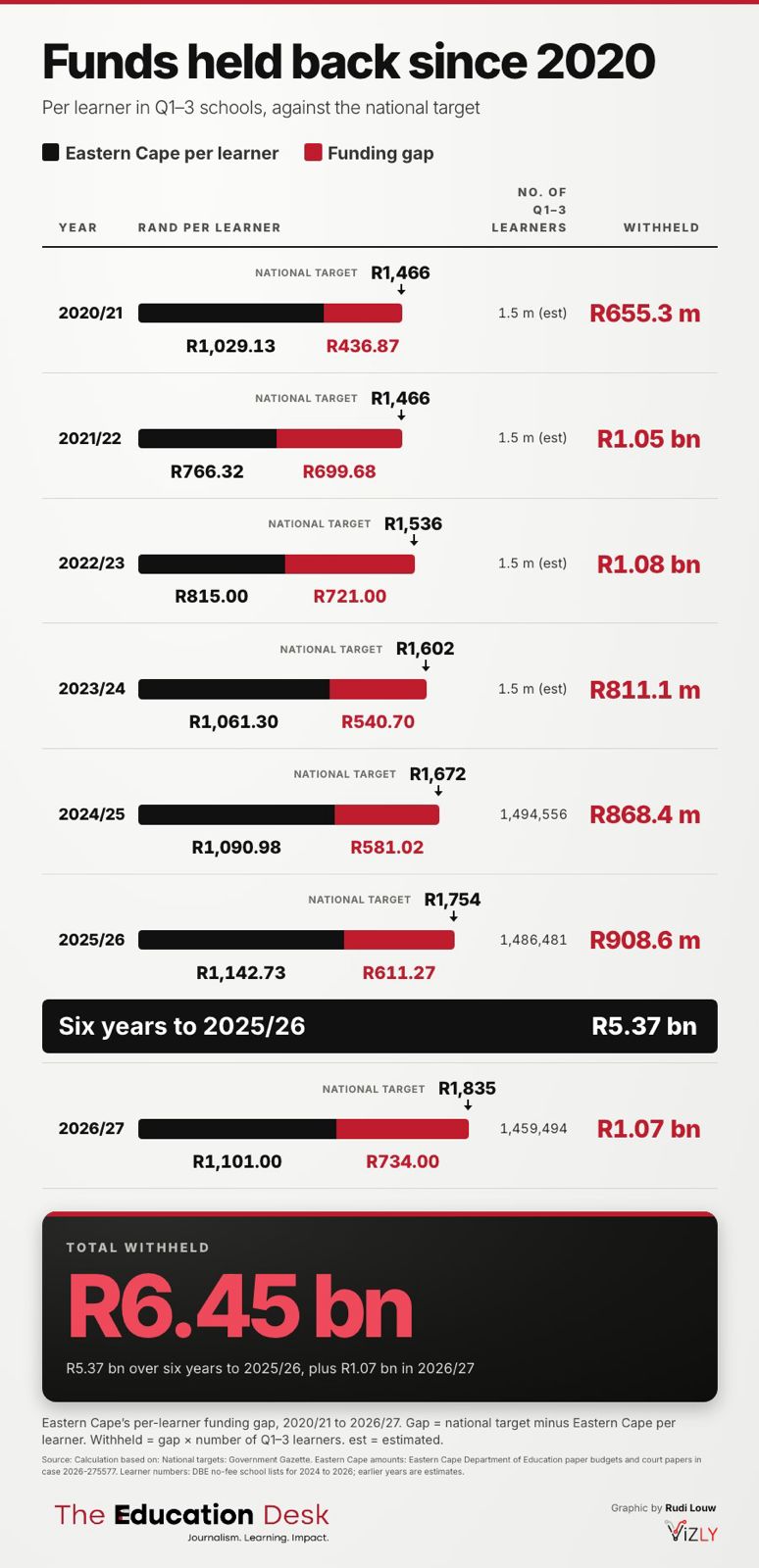
For no-fee schools in quintiles one to three, the 40% withheld cuts this year’s allocation from R1,835 to R1,101 per learner. Fee-charging schools receive smaller allocations. The department is withholding R367.60 per learner in quintile four and R126 per learner in quintile five.
On 19 August, by agreement between the parties, the court declared the withholding of 33.75% of school allocations in 2023/24 and 2024/25, and the reduction in per-learner funding from November 2020, to be “unconstitutional, unlawful and invalid”.
It ordered the department to report quarterly on how it would fully fund every school for 2027/28.
The order did not require repayment of earlier shortfalls. Budgets sent to schools show the department retained R834-million in 2023/24 and R894-million in 2024/25. Van Schalkwyk put the 2025/26 figure at about R932-million. With this year’s R1.1-billion, that comes to nearly R3.8-billion in four years.
GroundUp estimates that no-fee schools alone received R5.37-billion less than the national targets over the six years to 2025/26 (see table).
The department’s case
The August court order left open the question of whether this year’s 40% withholding was lawful. The case was pending when the department issued the 2026/27 school budgets in May.
In a statement on 24 August, the department said it had to meet the minimum per-learner target “with immediate effect”. It said the order did not require it to repay schools for earlier years or the current year.
In a written response to GroundUp on 24 November, the department would not say whether it will oppose the application. Its position “will be communicated through its formal court submissions”, it said.
It said buying centrally was meant “to improve equitable access to textbooks, stationery, furniture, municipal services, digital resources and targeted learner support”, particularly for rural schools. It put the centrally held amount at R1.06-billion.
However, it conceded that “central provisioning does not, by itself, establish compliance with the order”, and that the value of goods bought centrally “does not automatically extinguish statutory funding obligations”.
Asked whether a joint plan exists for 2026/27, it said this had “not yet been confirmed”.
Asked whether governing bodies were consulted, it said schools were informed in their budget letters.
The department said that if the court orders repayment, it will comply, but the effect on textbooks, furniture, municipal services and learner support “will need to be assessed”.
National Treasury, which is one of the respondents, has filed notice to oppose the application that the department pay the schools their full amount by 31 March 2027, according to the LRC.
Answering affidavits were due on 20 November. By 23 November, none had been filed, van Schalkwyk said.
According to the applicants, officials said the department’s budget had been cut for more than a decade while its responsibilities had grown. Grade R and mother-tongue-based bilingual education were introduced without sufficient additional funding. The department had a R570-million overdraft to repay this year and had carried R1.6-billion in unpaid bills into 2025/26.
Officials said the treasuries had told them to find the money within their budget.
The founding affidavit says officials asked the applicants whether they would consult on which central projects should continue and whether they would withdraw their instruction to litigate. The school said they remained open to talks on funding priorities but that choosing projects was the department’s responsibility, and it refused to drop the case.
Officials told the applicants in October that the money would not be paid this financial year.
“We want the court to compel national and provincial Treasury to assist the ECDE to come up with a plan for the repayment of the money,” van Schalkwyk said.
The ECDE’s first report under the August order is due on 30 November. Three days later, the court will hear argument on whether schools must wait another year for their full allocations.
Disclosure: The journalists work for the Rhodes University School of Journalism and Media Studies. The university is named in court papers as a partner of the Makhanda Circle of Unity.