Sponsored guest article.
Heavy industry puts people beside moving machinery and unstable ground for every hour of a shift. When something goes wrong, the outcome depends on how fast trained care reaches the injured worker.
Many remote operations sit far from that care, which makes on-site medical services a core part of site safety. A qualified on-site team can act in the first minutes after an incident. We explore why distance matters after a serious injury and what an on-site medical team can handle, from planned evacuation to day-to-day health and safety.
Why distance matters on industrial sites
How far mines sit from 24-hour care
A recent analysis of every operating mine in the country shows how far some industrial sites are from emergency care, using straight-line distance. Most of the furthest are in the Northern Cape, where the Alexander Bay diamond workings are 167 km from the nearest one.
Why minutes count after an injury
In 2024, the Department of Mineral and Petroleum Resources recorded 42 deaths and 1,841 occupational injuries in mining, then the lowest fatality count on record. Falls and machinery accidents cause crush injuries and severe bleeding, and uncontrolled bleeding can become fatal within the first hour.
Even an air ambulance has to fly in from its base before it can collect a patient. On a remote site, the care available in that hour is the care already there.
Other remote industries face the same gap
Mining has clear data, but the pattern holds wherever work moves away from towns. Wind and solar farms are often built on open land far from a city hospital. Offshore platforms put crews hours from shore, and pipelines cross long stretches of open country. Large construction projects can run for years on greenfield sites before any public services arrive.
All of these sites carry heavy plant and work at height, and they depend on how quickly a medic can get to an injured worker.
Evacuation follows a plan
Air transfer from remote sites
Some injuries need a trauma unit that an ambulance can’t reach in time. Air evacuation times depend on aircraft availability, weather, distance and the receiving facility.
Agreements in place before an incident
Without a standing air evacuation agreement, someone on site has to find an available aircraft and clear payment or medical authorisation while the patient waits. With one in place, authorisation is already settled, so the aircraft can be tasked as soon as the call comes in.
While the aircraft is on its way, a 24-hour control centre can coordinate the receiving facility, and the site medic can get a doctor’s input through telemedicine.
Day-to-day health and safety
Routine injuries and illness on shift
A site clinic handles everyday cases, from cuts and sprains to sudden illness. Treating these on site spares workers a long trip to town, and each case follows a clinical pathway back to work. Case reports show where injuries cluster, which helps the safety team decide what to change next.
Health surveillance catches risks early
Pre-deployment medicals confirm that each person is fit for the demands of their role and environment, including any vaccinations or prescribed treatment they need. Ongoing medical surveillance then tracks workforce health over time. It can flag occupational health risks while there is still room to change the exposure.
Both programmes also support compliance with health and safety obligations. The assessments can take place on site and be scheduled around shift patterns.
Training strengthens the first response
Co-workers are usually first at an injured colleague’s side. An on-site provider can deliver accredited first aid and fire courses at the workplace, matched to the operation’s own risks. Staff who know what to do in the opening minutes extend the reach of the medical team, and the training can count toward the site’s first aid requirements.
Conclusion
Hospitals are unlikely to move closer to remote operations. The gap has to close where the work happens. With a trained medical team on the ground and evacuation planned, care arrives soon after an incident. For any operation far from a 24-hour hospital, that coverage belongs in the safety plan from day one.
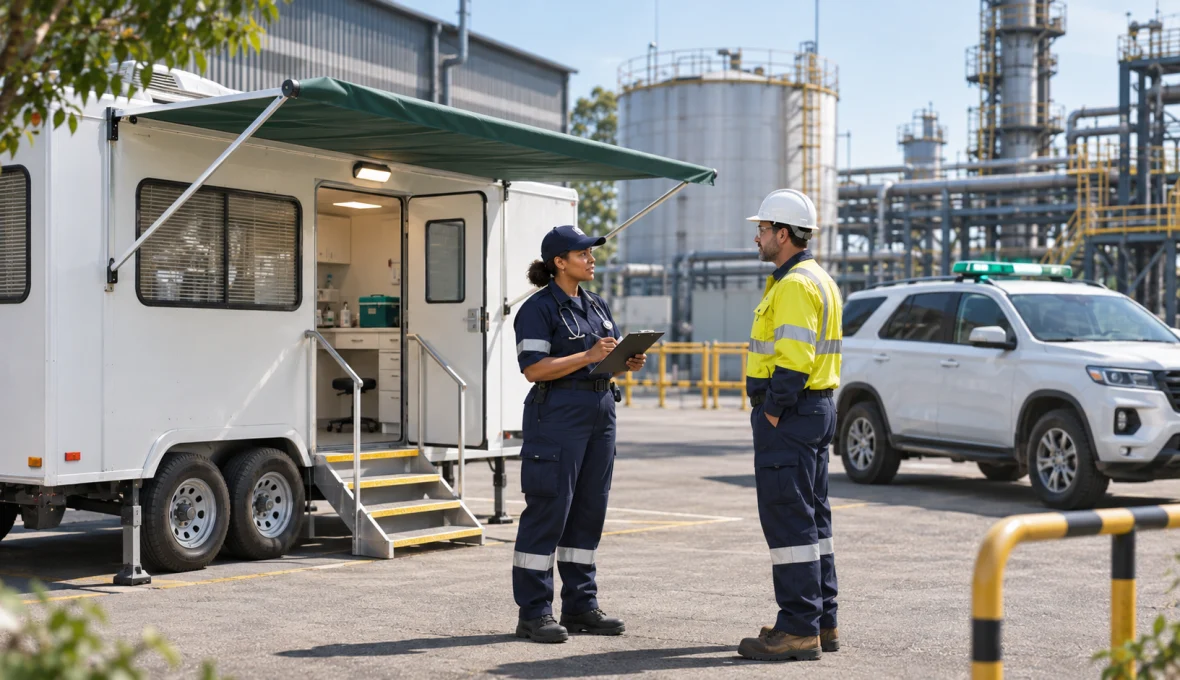
Featured image: AI-generated illustration of a generic industrial medical station; it does not depict an actual facility or event.