Illustration
Profile at a glance
- Full name
- Makhanda Nxele
- Known for
- Xhosa spiritual leadership, political counsel and resistance to colonial expansion
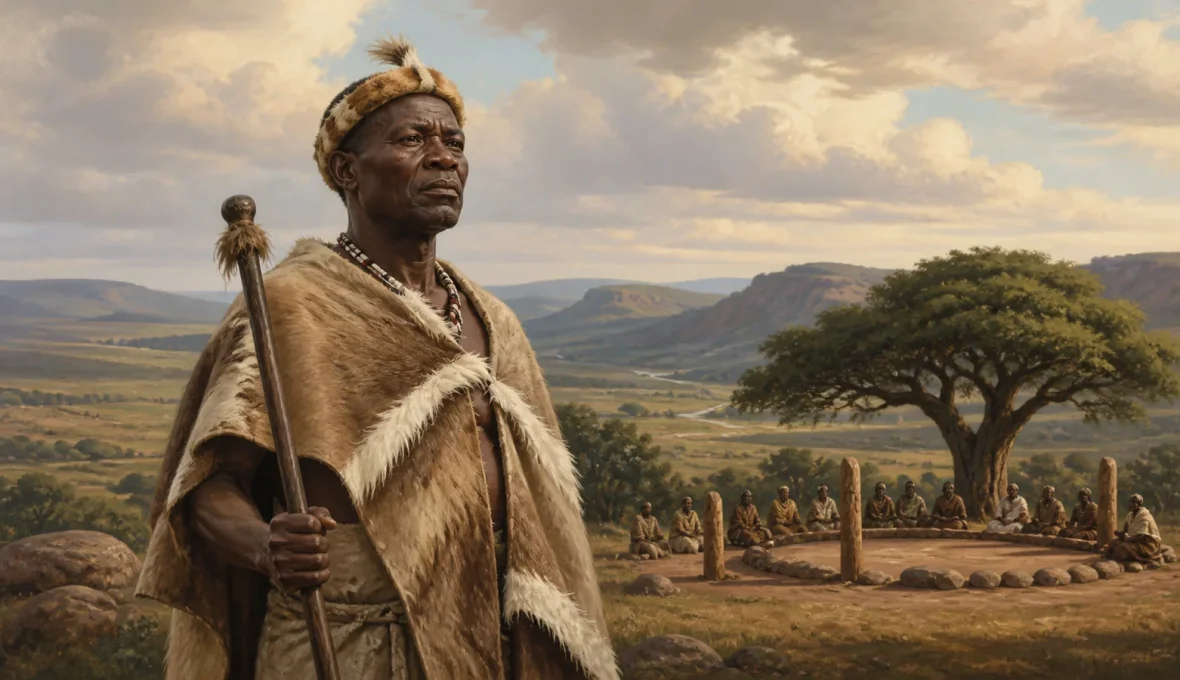
Makhanda Nxele—also known as Makana or Nxele—was an early-19th-century Xhosa spiritual leader, political adviser and resistance figure. He is most closely associated with the 1819 attack on the British military settlement at Grahamstown, the place officially renamed Makhanda in his honour. His life sits at the meeting point of Xhosa religion, missionary Christianity, frontier warfare and colonial expansion.
Who Was Makhanda Nxele?
Makhanda was born around 1780, although the precise year and place are uncertain. South African History Online places his possible origins near present-day Willowvale or the Qhagqiwa River. His father, Gwala, belonged to the amaCwerha clan; his mother was Khoi. The surviving record is uneven because much of what was written about him came from missionaries, colonial officials and later observers, while Xhosa oral traditions preserved other dimensions of his reputation.
He became known as Nxele, meaning “left-handed”, and rose from commoner status to become an itola, a spiritual and political figure associated with war preparation, counsel and communal wellbeing.
Early Life and Spiritual Formation
Accounts describe Makhanda as a contemplative young man who spent long periods alone and fasted. He was recognised as having a diviner’s calling and was taken into the orbit of Chief Ndlambe. There he gained influence as a religious adviser and public speaker.
His thought was not isolated from colonial contact. He engaged with missionaries and showed a serious interest in Christianity, reportedly staying at a mission station to learn and debate. He adopted some Christian concepts while retaining a worldview rooted in Xhosa spiritual life. Historians therefore caution against reducing him either to a Christian convert or to a simple opponent of European religion.
Rise to Prominence
Makhanda’s authority grew during a period of increasing pressure on Xhosa land and sovereignty in the Zuurveld, between the Sundays and Fish rivers. Competition among Xhosa leaders intersected with British military expansion, cattle raids, dispossession and contested colonial boundaries.
He aligned closely with Chief Ndlambe and became a prominent voice for resistance. His preaching fused moral reform, spiritual authority and political mobilisation. Rivalry with another influential prophet, Ntsikana, also shaped how later missionary accounts portrayed him.
The 1819 Battle of Grahamstown
In April 1819, thousands of Xhosa warriors advanced on the British settlement at Grahamstown. Makhanda played a central role in mobilising the force, while Mdushane, Ndlambe’s son, held an important command role. The attack was defeated by British firepower and Khoikhoi troops serving in the colonial force.
Colonial accounts often claimed that Makhanda promised warriors that bullets would turn to water. South African History Online notes that there is no reliable record of what he told the warriors before the battle. Treating that allegation as settled fact obscures the political causes of the conflict: land, sovereignty, violent raids and resistance to colonial expansion.
Surrender and Imprisonment
Later in 1819, Makhanda surrendered. Accounts describe the surrender as an effort to bring relief to his people after the war. He was transported to Robben Island without an ordinary trial and held apart from other prisoners because officials feared his influence.
In August 1820, prisoners attempted to escape from the island in boats. Makhanda drowned, although the incomplete colonial record and differing oral accounts have left aspects of his death disputed. His body was not returned to his family, and generations preserved the belief that he would return.
Challenges and Historical Debate
Makhanda has been depicted in sharply different ways: as a dangerous religious fanatic in some colonial writing, and as a liberation hero in later nationalist memory. A fair account must recognise both the limitations of the sources and his complex intellectual world. He engaged Christianity, criticised missionary power, drew on Xhosa religious traditions and acted within political conflicts that were not reducible to a single anti-colonial narrative.
His decisions also had devastating consequences for the force that attacked Grahamstown. Historical respect does not require ignoring the scale of that defeat or the internal divisions among Xhosa leaders.
Role in South African History
Makhanda’s story shows that resistance to colonial dispossession long predated the better-known liberation movements of the 20th century. It also demonstrates how religion, diplomacy and military mobilisation overlapped on the eastern frontier.
In 2013, descendants and public institutions held a symbolic ceremony to bring his spirit home from Robben Island. In 2018, Grahamstown was officially renamed Makhanda, following a public process that linked the place to the Xhosa leader whose forces attacked the colonial garrison in 1819.
Legacy
Makhanda remains a symbol of Xhosa sovereignty, spiritual innovation and resistance. His name now marks a major Eastern Cape city, while scholars continue to examine the colonial archive and oral history for a more complete understanding of his life.
His legacy is strongest when it is presented with evidence and nuance: neither the caricature created by hostile colonial sources nor an uncritical heroic legend is sufficient.
Did You Know?
- Makhanda was also known as Makana and Nxele; “Nxele” referred to his being left-handed.
- He was born a commoner but became a senior adviser in Chief Ndlambe’s political and spiritual circle.
- He engaged directly with Christian missionaries while developing his own synthesis of religious ideas.
- He was held on Robben Island before drowning during an escape attempt in August 1820.
- The Eastern Cape city formerly called Grahamstown was renamed Makhanda in 2018.
Related Historical Figures
Future related profiles should include Chief Ndlambe, Chief Ngqika, Ntsikana and Khoi resistance leader David Stuurman, who was also imprisoned on Robben Island.