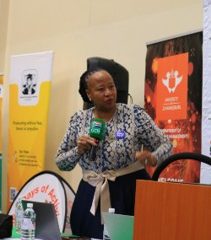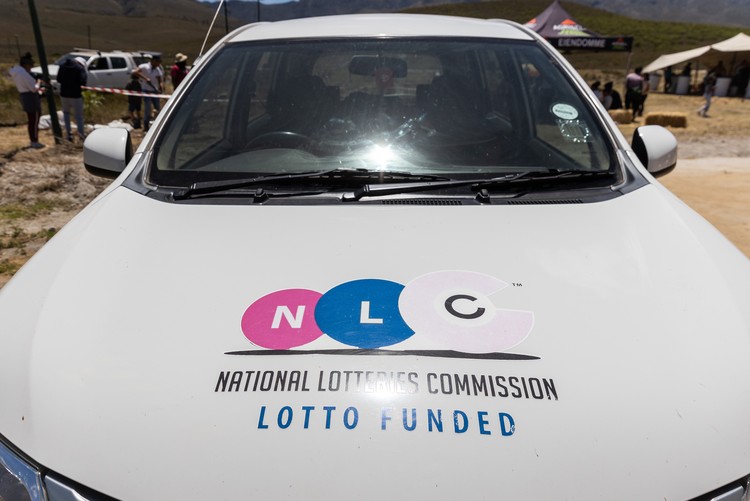
Corruption in the National Lotteries Commission has caused a scandal in the media industry. In this article we describe the details of a grant that resulted in the editor of the country’s largest newspaper being placed on special leave. Archive photo: Ashraf Hendricks
Previously we reported:
- Sunday Times editor Makhudu Sefara was placed on special leave after the Special Investigating Unit announced it was investigating a dodgy Lottery deal in which he was involved.
- Sefara has also stepped aside as editor of the South African National Editors Forum while the matter is investigated.
- The National Lotteries Commission gave R1.5-million to Todi Media Development Foundation, a company connected to Ngwako Malatji, to organise a one-day media event for about 50 community journalists.
- R900,000 of the money was paid to a company called Black Dangaree Enterprise and used to buy a house.
- A further R550,000 was paid to Sefara’s company, Unscripted Communications, to run the workshop.
- Malatji and Sefara would later both become editors of Sunday World, a newspaper linked to dodgy Lottery activities.
- Todi’s directors say they have repaid the money and acknowledged “regrettable mistakes and missteps”.
- Sefara has denied wrongdoing and said the media workshop event took place.
Today, we explain some of the details of this Lottery deal:
- From conception to allocation, payment for this grant, as well as to another company with two of the same directors, was made exceptionally quickly by the Lottery.
- There is nothing about the directors of Todi that indicated they were appropriate recipients of this grant.
- Funding for the event was proposed by the then Lottery grant manager, approved the following day, paid out in less than three weeks, and the event was held 20 days later.
- R1.8-million allocated to two companies in which Malatji’s wife was a director was used to pay for two properties registered in the couple’s names.
- In both cases, the money for the houses was funnelled through Malatji’s father’s company.
- The one-day event, if it took place, would have cost approximately R30,000 per attendee.
- How a hastily organised one-day media event fitted into the Lottery’s mandate of giving grants “intended for allocation to good causes” is unclear.
A company that received a R1.5-million Lottery grant for a one-day “community journalism workshop” had as its directors a “housewife”, a former media company driver, and a SASSA pensioner.
Publicly available business registration documents show that the directors of Todi Media Development Foundation were Martha Malatji, Khutso Daniel Makwela, and Sekedi Margret Rathethe.
Malatji, the wife of former Sunday World acting editor Ngwako Malatji, was described by three different sources as a “housewife”.
Makwela has no journalism background and previously worked as a driver for Tiso Blackstar, the former owner of both the Sunday Times and Sunday World.
Both Makwela and Rathethe, a SASSA pensioner, are from Moime village in Limpopo.
The grant was allocated by the NLC for a December 2018 media project that “included covering journalists’ accommodation, car hire, catering, equipment rental, guest speakers, marketing, security, etc” according to the Special Investigating Unit (SIU).
Instead, the SIU said that the funds were not used “for [the] intended purpose”.
Its investigation found that R900,000 was paid to Black Dangaree Enterprise and R550,000 was paid to a company called Unscripted Communication, directed by Makhudu Sefara.
Black Dangaree and the plethora of properties
Daniel Matome Malatji, who was the sole director of Black Dangaree, is the father of Ngwako Malatji, who would later become the editor of Sunday World in early 2023. He resigned from the paper soon after it was sold to new owners in September 2025.
Soon after receiving the money, the company paid R900,000, in December 2018, for a property purchased by Ngwako and his wife in Bassonia Rock Extension, Johannesburg, the SIU said.
Deeds office records show that a R1.85-million property in that area was registered in the name of Martha Malatji and her husband, a few months later, on 22 February 2019. There is a R950,000 ABSA bond on the property.
Records also show that Malatji and his wife jointly own nine properties, bought between 2018 and 2023, while he owns two properties registered in his name, purchased in 2007 and 2013. A further two that they bought together in 2018 have been sold.
Two of the three directors of Todi Media, Makwela and Martha Malatji, were also directors of Zibsiflo, which received R1.7-million from the NLC in 2020 for the “facilitation of a women’s soccer tournament in the Free State”, the SIU said.
In this case, R1.36-million from the grant was paid to Black Dangaree, which then paid R900,000 towards another property in Bassonia Rock on 26 June 2020.
Deeds office records show that the couple purchased a house on the same day for R2.3-million. It was registered in their names four months later, on 5 October 2020.
As with the Todi Media grant, the SIU said the funds were “not used for [the] intended purpose. Funds were misappropriated, and payments were made to Black Dangaree, which the Zibsiflo directors were unable to account for”.
Both grants were allocated under the previous board and executive of the NLC that was mired in corruption. They have been paid back in full to the SIU.
Todi Media, Zibsiflo and Black Dangaree have been deregistered for failing to submit statutory annual reports.
In a joint statement to GroundUp, Dan Makwela, Martha Malatji and Makwape Makgobatlou, directors of Zibsiflo and Todi Media Development Foundation, said they “acknowledge regrettable mistakes and missteps”.
“We accept that funds earmarked for charitable purposes must be managed with the highest degree of care, accountability and transparency. The SIU advised that the grants had not been used for their intended purposes and requested repayment. Both entities repaid the funds in full.”
The SIU said it would refer Black Dangaree and Todi Media to the NPA for money laundering.
Both Malatji and his wife failed to respond to specific questions about their property ownership and the grant for the media event.
Documents destroyed
When the SIU began investigating Todi Media, the NLC was unable to find the file relating to the grant. A source with direct knowledge of the investigation told GroundUp that the Todi file was among over 50 proactively-funded projects that were removed from the NLC’s grants system and destroyed.
Although the SIU was able to recover some information about the Todi grant from the NLC’s email archive, key documents like the grant agreement, the application for funding and the mandatory post-project final project report were never found, the source said.
Unscripted Communications
Sefara was the sole director of Unscripted Communications, and he too would later become an editor of Sunday World from July 2019 to October 2020. Sefara, via this company, was a spokesperson for Prophet Bushiri, a preacher, accused of rape and facing trial for fraud, who is now a fugitive.
Sefara has refused to answer questions from GroundUp. But in a public statement, he said that he was approached by Makwela and requested to organise a community media training event.
The SIU declined to comment on Sefara’s claim that the event had indeed taken place and that funds were “diverted” to his company.
SIU spokesperson Selby Makgotho said that Sefara had “reached out” and requested a meeting, which would take place on a date still to be confirmed.
Sefara wrote in his statement: “The event was held on 11 December 2018 at Birchwood Hotel, near OR Tambo Airport. Over 50 members of the community media sector (for both print and radio) attended the event (whose images are here attached). The guests were booked at Birchwood hotel (the receipt is also here attached).”
“There could be no doubt on whether or not the event took place. As CEO of a communications firm [at the time], I was entitled to pursue business which included organising community media workshops,” he wrote.
He said that the SIU’s claim that some funds were “diverted into private pockets to create an impression of impropriety on my part is not just false, and therefore harmful, but a poor strategy to use my name to generate undue publicity”.
Sefara said that the event took place and was attended by over 50 people. “Pictures and videos were taken at the event. Accommodation was paid for. Flights were booked and paid for.”
The event was held over a single day and dubbed a “Development Journalism Conference”, according to a copy of an invitation included in Sefara’s statement. It lasted eight hours, from 9am to 5pm.
Sefara claimed that the event was addressed by “the GCIS deputy head at the time, along with other speakers. I facilitated the event. If my company, a service provider, is guilty of receiving funds to organise an event, this must surely also mean the hotel, the airline, catering firms, and bus companies that received funds to accommodate, feed and transport these conference attendees are equally liable. It’s preposterous.”
But William Baloyi, the deputy government speaker at the Government Communication and Information System (GCIS) denied that it had participated in Sefara’s event.
“We don’t have on our records any event organised by the mentioned company [Unscripted Communication] that we participated in as GCIS. What we have on our records is an event organised by MDDA that was addressed by the then Minister, Ms Nomvula Mokonyane, on 31 July 2018.” It was a two-day event.
GroundUp has not seen the receipt or the images Sefara referred to in his statement. But we have seen an undated Birchwood check-in form identifying 40 of the people Sefara says Todi Media booked into the hotel. The hotel did not respond to an email asking if the event had taken place.
GroundUp contacted many of the people listed. Those we spoke to confirmed that they had attended a community media event at Birchwood in 2018. Some said they had attended a one-day event, while others spoke of a two, three or four-day event. It is possible that some attended the Todi Media event or the GCIS event, or both. But, understandably, they could not remember precise details eight years later.
What is clear is that the event was organised very quickly, with only 20 days between the grant being paid to Todi Media and the event. Travel, venue and accommodation, and speakers would presumably have been organised within this time.
Sefara says that he used a GCIS media list to select people to invite.
The common practice with donor-funded journalism events is to advertise them well in advance, inviting people to apply to attend. This allows the organisers ample time to select appropriate applicants and organise the logistics involved in staging the event.
Quick turnaround
The quick turnaround time for the Todi Media funding is striking. Former NLC grants manager Marubini Ramatsekia motivated for the grant under a mechanism known as pro-active funding, which was used to loot hundreds of millions of rands. It was approved by an NLC distributing agency the next day.
Ramatsekisa was placed on suspension in 2022 and subsequently resigned while facing a disciplinary inquiry into serious misconduct and fraud. He failed in a subsequent court bid to access his R1.7-million pension.
We have reported extensively on how the pro-active funding mechanism was used to bypass normal processes and facilitate corruption.
Less than three weeks after the grant was approved on 21 November 2018, the NLC paid R1.5-million into Todi’s account. The very next day, the company paid the first of three payments to Sefara’s company, totalling R450,000. A fourth payment of R100,000 was made to Sefara on 12 December, the day after the media event.
According to the NLC’s 2018/19 annual report, during the period in which the Todi payment was made, over 90% of applications received were adjudicated within 150 days. Once a grant agreement was signed, the NLC was tasked with paying out grants within 60 days.
A turnaround time of less than three weeks between Todi’s application and the grant being paid was unusually quick.
Source: Original report at GroundUp.

![[WATCH LIVE] ANC SG, Fikile Mbalula addresses a Community Meeting in Diepsloot.](https://www.ebnewsdaily.co.za/wp-content/uploads/2026/08/hqdefault-101-380x240.jpg)