Update 28 September 2026: Indonesia’s Foreign Ministry confirmed on 12 August that the vessel was MV Tihamah and that the Indonesian crew member previously reported missing was among the six people killed in the 11 August attack near the Bab el-Mandeb. Director Heni Hamidah said the dead included four crew members and two rescue personnel. Two other Indonesian crew members were injured. The earlier 13 August account below reflects what had been confirmed at that time. Source: Radio Republik Indonesia’s report of the ministry statement, https://rri.co.id/voice-of-indonesia/international/2646282/indonesian-fm-one-indonesian-crew-member-killed-in-mv-tihamah-attack
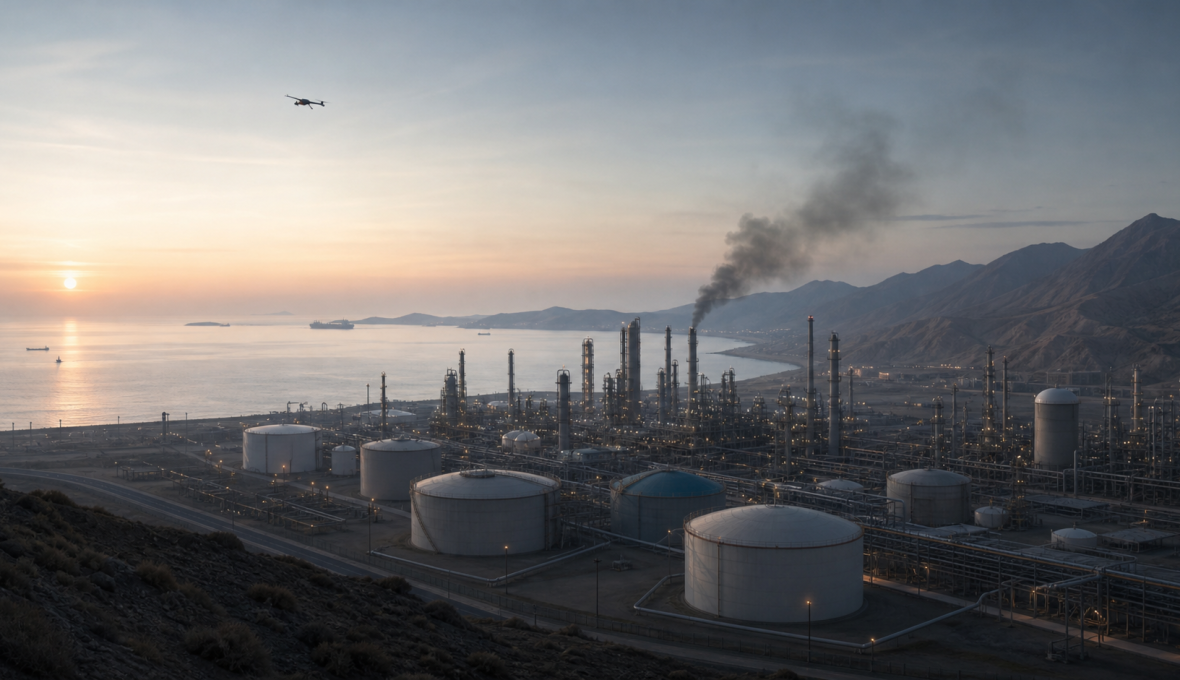
Yemen’s Houthi movement said it targeted a Saudi Aramco refinery in Jazan with a drone on Sunday, while Saudi Arabia’s Energy Ministry confirmed that a fire at a refinery facility had been extinguished without casualties. Saudi authorities did not publicly attribute the fire’s cause in the initial statement.
The two accounts establish that an incident occurred at the Jazan facility, but they do not yet independently prove that the Houthi drone claim caused the fire. That distinction remains important as the conflict around Yemen and Saudi Arabia intensifies and energy infrastructure again becomes a target.
Updated 13 August 2026, 23:20 SAST: survivors describe three-missile attack
Survivors have now described how a second missile hit the commercial vessel while the first rescue effort was under way. Associated Press reported on Thursday that Yemeni authorities said three ballistic missiles struck the ship in the Bab el-Mandeb, killing six people and injuring at least nine.
Pakistan’s foreign minister confirmed that three Pakistani nationals were killed and another was wounded. Indonesia’s Foreign Ministry said one Indonesian national remained missing and two were wounded. EBNewsDaily is not treating earlier reports of an Indonesian death as confirmed.
The new survivor accounts add detail to the sequence of the attack but do not resolve every discrepancy in the casualty reporting. The vessel’s identity and the complete casualty list had not been confirmed by sufficiently authoritative sources at the time of this update. The Bab el-Mandeb is a vital link between the Red Sea and Gulf of Aden, and the attack adds pressure to a shipping corridor already carrying greater strategic weight while the Strait of Hormuz remains disrupted.
What has been confirmed
Associated Press reported that Houthi military spokesperson Yahya Saree said the group launched a drone at the Aramco refinery in the southwestern Saudi city. He described it as a response to what the Houthis said were Saudi drone incursions over Yemen’s Hajjah and Saada provinces.
Saudi Arabia’s Energy Ministry reported a fire at a facility belonging to the refinery. It said the blaze was brought under control and that there were no casualties, but it did not give a cause or announce an immediate effect on refinery operations or fuel supplies.
No independently verified damage assessment was available at the time of publication. There was also no confirmed announcement of a shutdown or loss of production. Claims about the precise weapon used, its flight path and the point of impact therefore remain unverified.
Houthis also accused of attacking Mocha port
A Yemeni government official later said the Houthis had also launched missiles and drones at Mocha port on the Red Sea. Fayed al-Noman, an assistant undersecretary in the information ministry, described the facility as one of the main ports controlled by Yemen’s internationally recognised government.
Yemen’s Defence Ministry, operating under the internationally recognised government, said on Monday that seven people were killed and 30 injured in Sunday’s Houthi attack on Mocha. It said four military personnel and three civilians were among those killed. The revised toll remains attributed to the Yemeni government pending confirmation by a neutral international organisation.
Mocha has been renovated to handle shipping that avoids Houthi-controlled ports around Hodeida. There was no immediate Houthi comment on the port attack.
The reported port attack broadens the day’s escalation beyond Saudi energy infrastructure. If confirmed, it would show pressure being applied simultaneously to a refinery and to a commercial gateway on the Red Sea, a route already facing heightened security and insurance risks.
Why the Jazan incident matters
The reported strike follows a renewed cycle of attacks between the Houthis and Saudi-linked forces after years in which direct cross-border hostilities had eased. Earlier attacks in southern Saudi Arabia this week injured 11 civilians, including a child, according to the Saudi military.
Jazan lies close to the Yemeni border and includes infrastructure linked to Saudi Arabia’s refining and Red Sea energy network. Even when damage is limited, repeated attacks can raise security and insurance costs and increase concern about the resilience of regional oil facilities.
The incident also comes days after Saudi Arabia, Türkiye and Pakistan signed a mutual defence agreement. Turkish Foreign Minister Hakan Fidan said the pact was not directed at Iran or any other country, but its timing gives the agreement added significance as Saudi infrastructure faces attacks associated with Iran-aligned groups.
A wider regional escalation
The Houthis took control of Yemen’s capital, Sanaa, in 2014, prompting a Saudi-led military intervention the following year in support of the internationally recognised government. A United Nations-brokered truce in 2022 reduced large-scale fighting, although it did not produce a comprehensive peace agreement.
Recent attacks have weakened that relative calm. The Houthis have targeted Saudi-linked shipping and infrastructure, while Saudi-supported forces have carried out strikes against Houthi positions in Yemen. The escalation threatens to reopen a conflict that has caused a severe humanitarian crisis and left Yemen politically divided.
Tensions are also being amplified by the dispute over shipping through the Strait of Hormuz and renewed instability around the Red Sea and Bab el-Mandeb. Those waterways are critical to global oil and commercial shipping, meaning separate regional confrontations can quickly affect freight costs, insurance and energy markets.
Possible impact on South Africa
South Africa imports most of its crude oil and refined petroleum requirements. A single contained refinery fire in Jazan does not by itself establish a change in global supply, and no production loss was confirmed. However, sustained attacks on Gulf energy infrastructure or shipping routes can add a geopolitical risk premium to international oil prices.
For South African households and businesses, prolonged increases in international oil prices and freight costs can feed into fuel-price pressure, transport costs and inflation. The rand-dollar exchange rate remains another important factor in the local price effect. Readers can follow the latest currency movements through EBNewsDaily’s Markets and Forex service.
What happens next
Authorities are also expected to clarify the vessel’s identity, the status of the missing Indonesian crew member, the full casualty list and whether new maritime-security guidance will follow the Bab el-Mandeb attack.
The immediate questions are whether Saudi authorities identify the cause of the fire, whether Aramco reports operational disruption, and whether the Saudi-led coalition responds militarily. Independent satellite imagery or a detailed official damage assessment could clarify the competing claims.
Further attacks would indicate that the renewed Houthi-Saudi confrontation is moving beyond isolated incidents. Until more evidence is available, the confirmed facts remain limited: a fire occurred at the Jazan refinery facility, it was extinguished without reported casualties, and the Houthis claimed responsibility for a drone strike.
The Mocha port attack and casualty toll remain attributed to Yemen’s government-allied National Resistance Forces pending independent confirmation. EBNewsDaily will continue to update this article if authorities provide a detailed damage assessment or evidence of operational disruption.
Sources
- Associated Press, 9 and 13 August 2026 Middle East developments reports
- Pakistan and Indonesia foreign-ministry confirmations reported by Associated Press, 13 August 2026
- Saudi Energy Ministry statement as reported by Associated Press
- Saudi Press Agency statements on earlier regional attacks and energy infrastructure