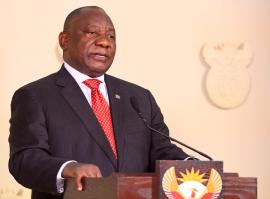
President Cyril Ramaphosa has announced the first wave of six priority green hydrogen projects under South Africa’s national green hydrogen programme, signalling a shift from project planning to implementation and investment.
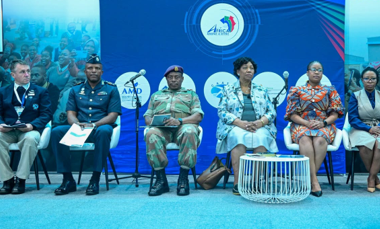
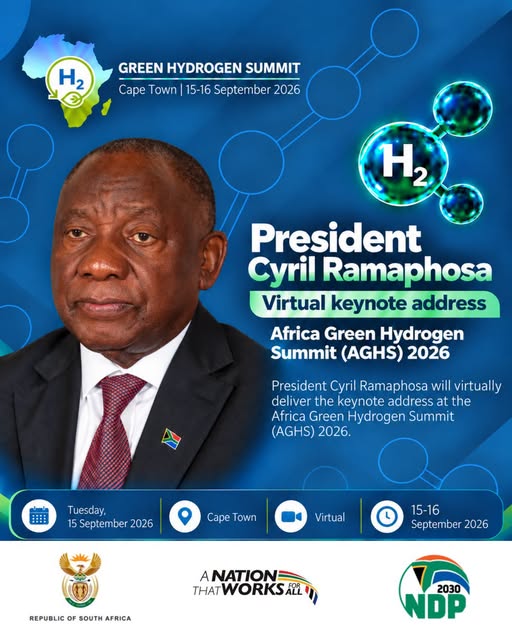
Addressing the African Green Hydrogen Summit in Cape Town on Tuesday, President Ramaphosa said the six projects emerged from a rigorous assessment process aimed at standardising project bankability and strengthening investor confidence.
The President’s address was delivered on his behalf by Electricity and Energy Minister, Dr Kgosientsho Ramokgopa.
Leading the first wave was the Phelan Green Group electro-Sustainable Aviation Fuel project in Saldanha Bay, which has reached final investment decision after securing an off-take agreement and a $100 million equity commitment.
Construction is expected to begin in the first quarter of 2027, with the first exports of electro-Sustainable Aviation Fuel targeted for the first quarter of 2029.
“This is an important milestone. As the World Economic Forum noted earlier this year, “the real bottleneck in scaling clean hydrogen is demand, not technology”. Scaling therefore rests on securing long-term offtake agreements.
“This project gives practical meaning to the challenge we made at last year’s Summit: an investment decision has been taken, equity committed, major equipment ordered and a defined route to construction established. What follows is production and offtakers,” President Ramaphosa said.
As a managed priority portfolio, the President said the first wave concentrates project preparation, investment mobilisation and government coordination on credible projects with defined milestones.
The remaining five projects in the first wave span key areas of the green hydrogen value chain.
The Coega Green Ammonia Project in the Eastern Cape has completed early preparatory work but requires further commercial, technical and financing work before reaching final investment decision.
The Saldanha Hydrogen Direct Reduced Iron Project on the West Coast is at pre-feasibility stage and will link green hydrogen to lower-emissions iron and steel production.
The Prieska Power Reserve in the Northern Cape is a green ammonia project targeting the domestic market and is currently at development stage.
The Green e-Fuels Producers Green Methanol Corridor is at pre-feasibility stage and is targeting European demand, while the Green Hydrogen Solutions Project, focused primarily on South African demand, has completed front-end engineering design.
“By designating these as priorities, government and its partners now have a mechanism to help the remaining five projects reach final investment decision, construction and production. A second wave of projects will follow, bringing further credible projects into the portfolio,” President Ramaphosa said.
The President said Africa has an opportunity to become a major global hub for green hydrogen, supported by its abundant renewable energy and water resources and reserves of critical minerals.
However, he warned that the continent should not remain merely a supplier of renewable energy, minerals or hydrogen molecules.
“Africa must participate across the value chain as owner, manufacturer, technology partner, producer and market.”
He said the green hydrogen economy must contribute to Africa’s industrialisation through areas such as fertiliser production, green iron and steel, sustainable fuels, equipment, engineering and related services.
The President noted that the development of the green hydrogen economy will be aided by the African Continental Free Trade Area, which will open larger markets and enable seamless regional value chains.
“The green hydrogen economy must harness African talent and capacity for innovation while expanding local procurement, manufacturing, employment and skills transfer. It must sustainably support continental energy transition and decarbonisation. It must involve communities as stakeholders, not passive bystanders,” the President said.
The President also called on technology partners to establish manufacturing, training and research capacity on the continent, warning that Africa should not simply be seen as a market for imported equipment.
“African nations must step up practical cooperation on standards, certification, infrastructure corridors and project preparation, including through the Africa Green Hydrogen Alliance. While we continue to work with our BRICS (Brazil, Russia, India, China and South Africa) and European partners to diversify financing, African development finance institutions must be at the forefront,” President Ramaphosa said.
African development finance institutions, he said, should increase project-preparation funding and provide financing instruments suited to the risks associated with first-of-a-kind projects.
He also called on prospective buyers to convert non-binding expressions of interest into credible, long-term offtake agreements capable of supporting project finance.
“Since last year’s Summit, we have moved from an undifferentiated pipeline to a managed priority portfolio. This demonstrates that with partner support, public and private financing and proper planning, African nations can move from a concept on paper to projects in development,” the President said. – SAnews.gov.za
Source: Original report at SAnews.gov.za.