
Government has identified R38.1 billion in savings over the medium term as it works to improve the quality of spending and direct funds towards efficient and effective programmes.
The savings form part of a shift away from incremental, input-driven budgeting towards strategic decisions based on outcomes, affordability and value for money.
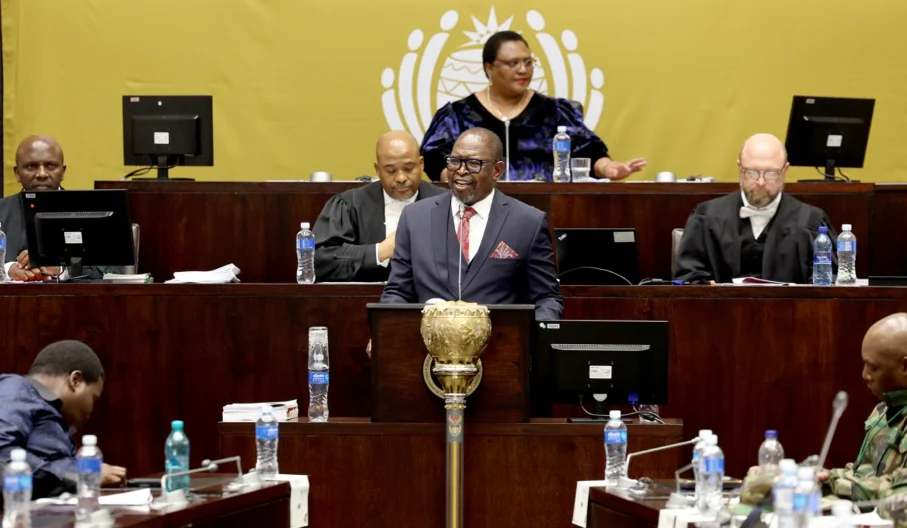
Finance Minister Enoch Godongwana said government is phasing out programmes that are no longer fit for purpose.
“We are also restructuring underperforming and inefficient programmes, and reducing administrative inefficiencies and fraud in programmes,” the Minister said on Wednesday while delivering the Medium-Term Budget Policy Statement (MTBPS) in Parliament on Wednesday.
In addition to the R12 billion identified in the 2026 Budget, a further R38.1 billion has been identified over the 2027 Medium-Term Expenditure Framework (MTEF) period:
• R11.7 billion from low-priority programmes and measures to reduce duplication and administrative inefficiencies in national departments;
• R13 billion from reducing fraud in social grants;
• R7.8 billion from the human settlements development grant, where programme inefficiencies and rent-seeking have resulted in less spending on building houses; and
• R5.5 billion from surpluses in public entities.
Godongwana said efficiencies and savings could also be found in provincial budgets. For example, implementing more effective remuneration policies for healthcare workers could enable provinces to employ more health professionals.
The National Treasury’s MTBPS document emphasised that improving the quality of spending by allocating funds to efficient and effective programmes is a fundamental reform of the budget process.
“Targeted and responsible savings are identified by assessing programmes on a common basis and asking key questions. Are programmes legally required? Are they aligned with policy priorities?
“Do they efficiently deliver measurable outputs and outcomes? Is there persistent underspending or poor performance? Could the same objective be achieved at lower cost or through a better institutional arrangement?”
“Government will continue to reduce leakage and fraud by improving administration and verification, redesigning programmes that fail to meet their objectives, redirecting funds from low priority, inefficient or duplicated activities and addressing accumulated cash surpluses in public entities,” National Treasury explained.
These savings have been reprioritised and redirected across the fiscal framework.
Revised spending for 2026/27
The 2026 Adjustments Appropriation Bill proposes an upward adjustment of R10.6 billion to expenditure.
This includes R1.9 billion in rollovers from the previous financial year and R6.2 billion for unforeseeable and unavoidable expenditure, mostly for disaster relief.
An additional R2.2 billion is provided for early-retirement and voluntary-exit packages for qualifying public servants.
A Special Appropriation Bill for 2026/27 is proposed, allocating a total of R6.9 billion, mainly to the South African Revenue Service.
“Government will allocate R10 billion of the in-year revenue overrun to the contingency reserve for the El Niño response and other risks. The remainder is a provisional allocation for infrastructure projects currently under evaluation by the Budget Facility for Infrastructure,” National Treasury said.
In the adjustments budget, R150 million is allocated to enhance the technical capabilities of the digital services unit, which will lead the development of the MyMzansi app. The app will allow citizens to access government services through a single digital platform.
A further R20 billion has been earmarked for infrastructure projects currently under evaluation by the Budget Facility for Infrastructure.
In-year adjustments
The Minister said the additional revenue in 2026/27 means government can increase expenditure by R45.5 billion compared with what was announced in February.
Together with allocations from the contingency reserve, the Adjustments Appropriation Bill includes:
• R6.2 billion for unforeseeable and unavoidable expenditure, mostly for disaster relief and rehabilitation;
• R1.9 billion rolled over from the previous financial year;
• R4.3 billion in self-financing expenditure;
• R823 million for the South African National Defence Force to deploy troops to assist the police in fighting gang-related crime and combating illegal mining; and
• R516 million for the Madlanga, Khampepe and Nkabinde commissions of inquiry.
–SAnews.gov.za
Source: Original report at SAnews.gov.za.


