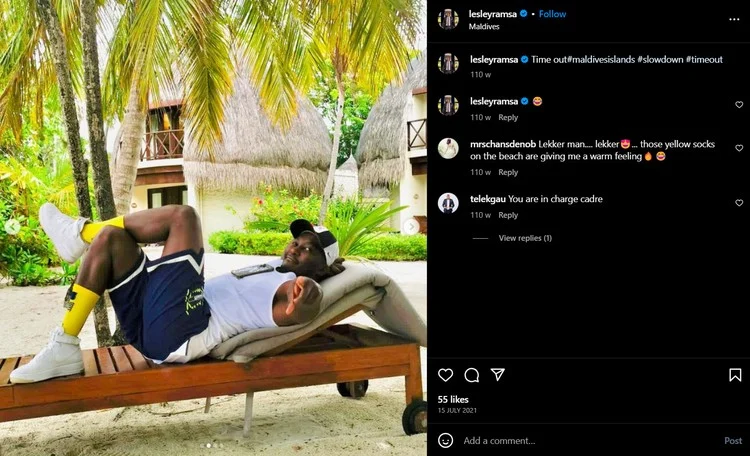
A photo from Lesley Ramulifho’s Instagram page showed him jet-setting around the world. Here he is in the Maldives. Archive photo: Lesley Ramulifho’s Instagram page (fair dealing)
- The Gauteng High Court suspended lawyer Lesley Ramulifho on 22 October until February 2027, pending a Legal Practice Council (LPC) application to have him struck off the roll.
- The LPC accuses him of hijacking non-profit organisations to obtain Lottery grants, which were diverted to buy Ocean Basket franchises, properties and a vehicle. It also accuses him of misusing trust money, including about R2-million from a R4-million coal transaction.

- The council says Ramulifho submitted fabricated bank statements to obtain audit exemptions and used a forged affidavit in an attempt to stop GroundUp reporting on him.
- Ramulifho has denied wrongdoing in various forums, but opposed the suspension application, filing his answering affidavit months late.
Dodgy lawyer Lesley Ramulifho, who is implicated in the looting of the National Lotteries Commission (NLC), has been suspended from practice.
In an order handed down at the behest of the Legal Practice Council (LPC) by Gauteng High Court Judges Nomonde Mngqibisa-Thusi and Mncedisi Kumalo, Ramulifho was immediately suspended on 22 October.
The matter was heard in Pretoria and decided on the same day.
His suspension will prevail until February next year when the matter will return to court in the LPC’s bid to have him removed from the roll.
In the meantime, he cannot practise law, and a curator, appointed by the LPC, will take over the running of NLR Attorneys, the firm he founded and has run since 2010.
The LPC claims in its affidavit that he submitted fraudulent bank statements in order to claim “exemptions” from submitting annual unqualified audit reports and that he hijacked non-profit organisations to fraudulently score funding from the NLC which he splurged on restaurant franchises.
He is also accused of stealing money from his trust account and forging signatures and bank statements in an attempt to gag GroundUp from reporting on his alleged illegal antics.
In his 126-page affidavit (which excludes annexures), LPC Gauteng director Ignatius Briel concludes: “His conduct reveals character defects which cannot be tolerated. He has damaged and affected the good standing and reputation of the profession.”
Briel said that “considered holistically”, it could only be concluded that Ramulifho had attempted to mislead the regulatory body, manipulated documentary processes, misused monies entrusted to him, and “placed his own interests above those of the public, his clients, the profession and the administration of justice”.
These were not mere remedial lapses, Briel said, but a demonstration that he should be struck from the roll of practitioners.
In various forums, Ramulifho has denied any wrongdoing. However, he has snubbed LPC inquiries set up to examine complaints against him.
Latterly, in a complaint lodged with the LPC by GroundUp, the investigating committee adjourned the matter without setting a date. Ramulifho was a no-show, his legal team arguing that he was too ill and was overseas.
He was ordered to supply his air ticket and doctor’s certificate. According to Briel, he has yet to comply.
Ramulifho opposed the LPC’s application but did not file an affidavit on time. The answering affidavit was due on 4 August, but only filed on 21 October, a day before the hearing. He must now apply for condonation for the late filing by Friday, 5 November 2026, otherwise the court will not consider his affidavit.
In its affidavit, the LPC describes the many complaints against him, including one by a company which was involved in a R4-million deal to buy coal. The parties agreed to a lesser price, but the balance of the money, about R2-million, which should have been in the firm’s trust account, disappeared.
It later emerged that bank records produced by Ramulifho in his audit exemption attempts did not reflect the R4-million payment at all.
Ramulifho firstly claimed that the company was not his client; he had withdrawn the money and paid it over on the instructions of his clients. When the LPC asked why it had never been reflected in his bank statements, he claimed it had been mistakenly deposited into the firm’s business account, an administrative oversight.
He used the same excuse as to why the bank statements he submitted to the LPC for audit exemptions differed from those given to the LPC directly by his bank.
Briel described them as “fabricated” and any innocent explanation as “implausible”.
Referring to a complaint received by the Special Investigating Unit (SIU), regarding Ramulifho’s alleged role in the hijacking of non-profit organisations and theft of grant fund money, Briel said this was most disturbing.
“The material furnished by the SIU establishes, at the very least on a prima facie basis, that monies allocated by the NLC for legitimate public benefit purposes were diverted away from those purposes and applied for [Ramulifho’s] personal benefit and the benefit of entities associated with him.”
He said funding intended for community projects had been transferred into Ramulifho’s personal and business accounts and used to buy Ocean Basket franchises, properties and a motor vehicle.
“In plain terms, monies intended for vulnerable and deserving beneficiaries were appropriated for private enrichment. Such conduct is profoundly dishonourable …”
Regarding the complaint by GroundUp, Briel said it reinforced the conclusion that the concerns surrounding Ramulifho’s conduct were neither isolated nor accidental.
Briel said that on the information available, he had fabricated or falsely presented a duly commissioned affidavit, in circumstances where the signatory had confirmed that he had neither signed it nor appeared before a commissioner of oaths.
“The commissioning of an affidavit is not a mere procedural formality. It is a solemn juridical act intended to ensure authenticity, accountability and evidential reliability. To create, procure, use or rely upon a purported affidavit … is to perpetrate fraud upon the administration of justice itself,” Briel said.
© 2026 GroundUp. This article is published under the GroundUp Republication Licence Version 1.0. Email [email protected] to request permission to republish.