Access to justice is a fundamental human right that must find expression in the everyday lived reality of ordinary citizens.
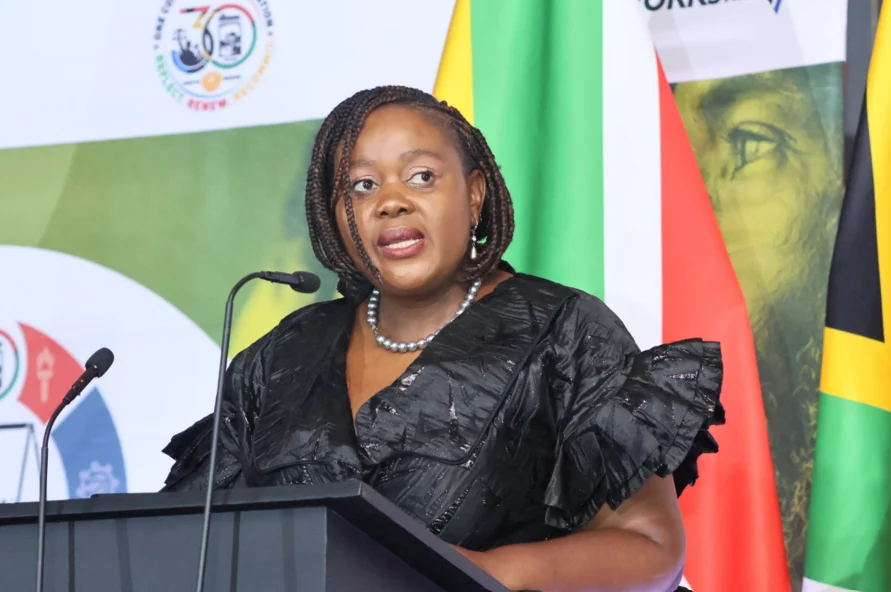
This is according to Minister of Justice and Constitutional Development, Mmamoloko Kubayi, who addressed the Access to Justice International Conference welcome dinner held on Wednesday evening.
The conference is being held at Sun City in the North West and will conclude later this week with President Cyril Ramaphosa expected to deliver the opening address.
“Let us leave this conference united by a common conviction: That justice is not the concern of lawyers and judges alone. It is the foundation of peaceful societies. It is the guardian of human dignity. It is the protector of freedom. And it is the bridge between constitutional promises and lived human experience.
“For when justice is accessible, rights become meaningful. When rights become meaningful, people are empowered. Empowerment leads to prosperity and when societies prosper under the rule of law, the promise of democracy is fulfilled,” Kubayi stated.
30 years of the Constitution
The conference coincides with South Africa’s commemoration of the 30th anniversary of the Constitution which the Minister described as a call to action.
“May future generations look back on this moment and say that we did more than celebrate thirty years of constitutional democracy.
“That we renewed its purpose. That we expanded its reach. And that we brought the promise of justice closer to every person. Justice must never be the privilege of the few. It must be the birthright of all,” she emphasised.
The Minister noted that over the past three decades, government has worked to bridge the gap between constitutional promises and daily reality by dismantling apartheid-era laws, rationalising magisterial boundaries to bring courts closer to communities, and establishing specialised courts for domestic violence, sexual offences and land claims.
Frontline support through Legal Aid South Africa and Community Advice Offices has further expanded access for indigent citizens.
Justice for all
The Minister noted that people encounter justice long before entering a courtroom.
“The world is witnessing a profound transformation in the understanding of justice. Historically, access to justice was often reduced to access to courts. While courts remain indispensable guardians of constitutionalism and legality, experience has taught us that people encounter justice long before they enter a courtroom.
“Justice is encountered when a victim reports a crime. When a woman seeks a protection order. When a child receives legal assistance. Around the world, governments and justice institutions are increasingly embracing what has become known as a people-centred approach to justice.
“This approach starts not with institutions, but with people, not with procedures, but with outcomes,” Kubayi said.
The digital divide
While welcoming digital transformation, electronic filing and artificial intelligence as tools to ease court backlogs, the Minister cautioned that unequal connectivity and digital literacy must be addressed so technology closes the justice gap rather than digitising it.
“Across every region of the world we see innovation as digital technologies continue to transform justice platforms are reducing barriers to access. Online dispute resolution mechanisms are making remedies more affordable. Community justice centres are bringing services closer to citizens and alternative dispute resolution mechanisms are easing pressures on courts.
“Digitalisation, artificial intelligence, electronic filing, virtual hearings and online dispute resolution provide extraordinary opportunities to make justice faster and more accessible. But if technological transformation is undertaken without addressing unequal connectivity, affordability, accessibility and digital literacy, we risk replacing one barrier to justice with another.
“Our principle should therefore be to use technology to close the justice gap, not digitise it. Equally, as artificial intelligence becomes increasingly integrated into justice administration, technological advancement must remain anchored in human rights, transparency, accountability and judicial independence,” she explained.
Kubayi noted that equally, access to justice depends on “public trust, integrity and accountability”.
“Corruption and institutional failure weaken confidence that institutions will act fairly and that the law applies equally. A citizen must be able to believe that no person is above the law and that the justice system will act independently, lawfully and without fear, favour or prejudice.
“For that reason, integrity, accountability, effective prosecution, asset recovery and international cooperation are not separate from access to justice. They are among its essential foundations,” the Minister highlighted.
She noted that as South Africa transitioned into a democratic state 32 year ago, Former President Nelson Mandela called for each generation to safeguard the hard-won freedom.
“Our generation has inherited this responsibility. Not only to safeguard freedom, but to deepen justice. Not only to protect rights, but to make them real. Not only to strengthen institutions, but to ensure that they serve the people in whose name they exist.
“As we commemorate the thirtieth anniversary of our constitutional democracy, let us recommit ourselves to the vision tat inspired its founding: a society based on human dignity, equality and freedom,” Kubayi said. – SAnews.gov.za
Source: Original report at SAnews.gov.za.