Your grandmother in Windhoek, the capital of Namibia, is struggling to breathe. You call the public ambulance service, but you’re told it could take more than 24 hours to arrive, if it comes to your area at all. So you make the only call that might actually save her: the City of Windhoek’s ambulance service. It arrives quickly. It also comes with a bill of 800 Namibian dollars (about US$50).
If you can’t pay on the spot, the city doesn’t turn you away, it simply adds the charge to your municipal account alongside your water and electricity. That should be a relief. In practice, it becomes a trap. Fall behind on that bill, and the city can cut your water and power.
So, families borrow to keep the lights and taps on, turning an emergency transport fee into a long-term debt.
This is not a rare story. It is a pattern researchers, including the authors of this article, heard in interviews with caregivers and older person households across Namibia. And it does not end with the ambulance. Roughly one in ten older Namibians now holds a personal loan with NamPost, the national postal service operator which also provides banking services, borrowed against their old age grant to cover these kinds of medical and household emergencies. A loan of N$13,000 (US$804) can end up costing nearly N$25,000 (US$1,500) to repay, N$420 (US$25) a month for five years, locking recipients of a grant meant for subsistence into years of debt.
The findings are outlined in a new report by the Family Caregiving of Older Persons in Southern Africa Programme.
The study was led by a team that we were part of, specialising in sociology, social work and psychology and exploring elder care in Namibia.
Drawing on the experiences of 80 households made up of older people and their family caregivers, the report’s central argument is stark: disability is produced as much by environment as by the body. Manageable health conditions become crises because of failing housing, absent sanitation, unaffordable assistive devices and precarious income. It falls to unpaid family caregivers to absorb these crises.
The report’s authors conclude that care in Namibia is determined by broader social and economic forces: unemployment, gendered expectations and the absence of adequate state support. When caregivers were asked what would help, their priorities were consistent: pension increases, a dedicated caregiver’s allowance, food security, basic infrastructure such as water and electricity, and recognition of labour.
A physical environment built to disable
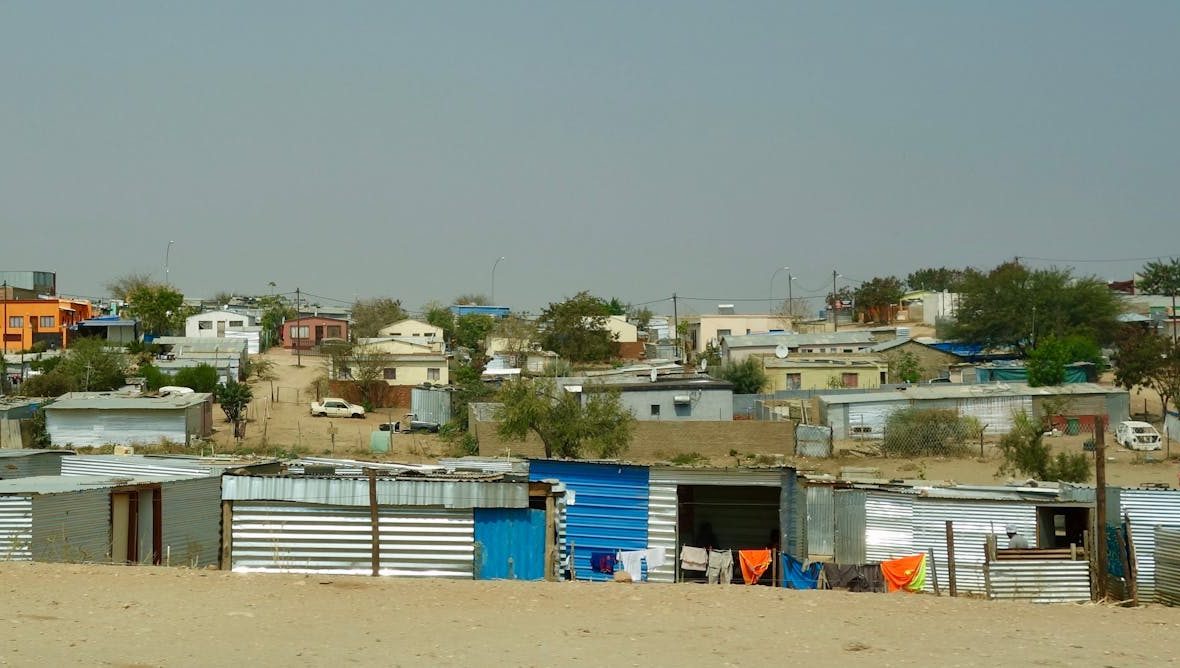
If you walk into an older person’s home in the urban, rural or informal settlement parts of Khomasdal (a large suburb northwest of the capital, Windhoek), Samora Machel (also in Windhoek), Windhoek Rural, Okatana or Mashare (northern Namibia), the first obstacles to care are rarely medical. They are structural: a zinc roof that turns a room into an oven by midday and floods it in the rains; a toilet too far from the house, or none at all; a doorway too narrow for a wheelchair; and no money to adapt it.
Sixty-three percent of older person households in Namibia lack toilet facilities close by. This forces caregivers to dispose of human waste.
Zinc and corrugated-iron housing floods in wet weather and overheats in summer, aggravating chronic conditions. Terrain around many homes is inaccessible.
The report’s findings show the environment magnifies people’s care needs. Hypertension affects roughly half the older people in Namibia; mobility problems affect one in five; eye conditions affect a third.
Multi-generational households
Households in the research often had eight or more members. Three-generation households were common in both urban neighbourhoods and rural settlements. Almost half of the older people studied lived with both adult children and grandchildren.
Urban households faced spatial constraints: small, crowded dwellings with little room to accommodate a bed-bound relative or a wheelchair.
Rural households drew on larger homesteads and agricultural land. But researchers found this space came at the cost of infrastructure: water and firewood had to be fetched from a distance.
In all but eight of the 80 households, the primary caregiver lived in the same home as the person they cared for. Only three households could afford paid help.
Most caregivers were women – 59 of the 80 primary caregivers studied – and relatively young. The largest age groups fell between 18 and 39. At least half were also raising children of their own.
Their work was continuous. Feeding, bathing, toileting, giving medication, fetching water and firewood, and providing companionship.
A pension stretched past its limits
Namibia’s old age grant – valued at N$1,400 (US$87) during fieldwork and now roughly N$1,700 (US$105) – sits at the centre of nearly every household budget. It is expected to support entire multigenerational households averaging 6.5 people.
Mapping monthly budgets across the 80 households, researchers found spending on food, utilities, medication, debt and school fees used up the grant well before the month was out. Household incomes in rural areas were lower and therefore costs such as food, transport or debt repayments took up a larger percentage of more limited income.
Utility and infrastructure costs were chief among the environmental pressures on that budget. Combined water and electricity costs consumed 25% to 40% of household income in some areas, with several households describing being cut off entirely and left paying off multi-year arrears while still struggling to afford daily power and water.
Medication stock-outs at public facilities pushed families toward private pharmacies at a cost of N$1,000 (US$61) to N$4,500 (US$278) over three months. Loan repayments, mostly to NamPost, absorbed an average of 15% of household income, rising to 27%-29% in Mashare and Windhoek Rural.
Household incomes in rural areas were lower and therefore a debt repayment took up a larger percentage of more limited income.
Other income sources such as remittances, informal trade, Harambee food parcels (state funded aid for particularly vulnerable households) and drought relief, were irregular and reached only a fraction of households.
Families coped through subsistence farming, wild fruit harvesting, informal trade and strict rationing.
What needs to be done
Interventions should coordinate social protection, health, housing, infrastructure and climate adaptation policies.
They should also recognise that family caregivers are essential partners in the care system.