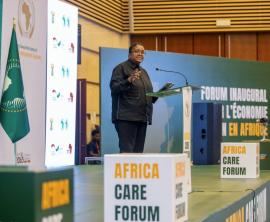
Deputy Minister in the Presidency for Women, Youth and Persons with Disabilities, Mmapaseka Steve Letsike, has called on African governments to move care work from the margins of economic policy and recognise it as essential infrastructure underpinning growth, employment and social development.
Addressing the African Union Commission’s inaugural Africa Care Forum in Addis Ababa on Wednesday, Letsike said Africa’s economies cannot achieve inclusive growth while childcare, healthcare, disability support, domestic work and other forms of paid and unpaid care remain undervalued and disproportionately carried by women.
“Care is not the soft edge of the economy; it is the infrastructure that makes the economy possible,” Letsike said.
The Deputy Minister is representing South Africa at the three-day Forum, which is currently underway under the theme: “Placing Care at the Centre of Africa’s Development Agenda”. The Forum seeks to advance an African care agenda and address the burden of unpaid care work.
Letsike urged governments to incorporate care into national planning, budgets and public investment, arguing that inadequate water, transport, childcare, healthcare and social protection systems effectively shift the cost of care onto women’s unpaid time.
“When water, transport, childcare, healthcare and social protection are absent, women’s time becomes the infrastructure. These burdens fall differently on rural, migrant and displaced women, women in informal settlements, women with disabilities, and queer women.”
She called for care systems that protect the rights and dignity of both those receiving and providing care, including through fair remuneration, safe working conditions, social protection and participation in decisions affecting care work.
Letsike warned against treating care as the sole responsibility of women and families, saying responsibility should be shared among households, men, communities, employers and the state.
“Ubuntu cannot mean that women must absorb every failure of the state and the market. It must mean that our shared humanity produces shared responsibility, expressed through institutions, budgets and decent work.”
Africa, she said, is not starting from scratch in developing a care economy, pointing to extended households, community health workers, early childhood programmes, home-based carers, domestic workers, disability organisations and cooperatives that have sustained communities through childhood, illness, disability, ageing and crisis.
She highlighted initiatives in Cabo Verde, Malawi, Ethiopia and Rwanda as examples that could inform national care systems, while noting that countries should develop approaches suited to their own circumstances.
“South Africa can build on social protection, community health services, early childhood development, home- and community-based care, school nutrition and the social sector of the Expanded Public Works Programme.”
However, she warned against romanticising community-based care where it continues to depend on women’s unpaid labour, low wages and limited protections.
Letsike said the economic contribution of care must be better measured through time-use, service and expenditure data so that it is reflected in policy and budgets, while warning against reducing care solely to its monetary value.
“We must make care economically visible without making dignity depend on a market calculation.”
Advancing the care economy
The Deputy Minister said the continent already has a policy and legal foundation for advancing the care economy, including Article 13 of the Maputo Protocol, which recognises the economic value of women’s work in the home, as well as the African Union’s Agenda 2063.
She called for costed care plans to be incorporated into medium-term budgets, supported by care-budget tagging and expenditure reviews. Public investment should prioritise childcare, health, disability support and long-term care, alongside water, sanitation, energy and transport infrastructure that can reduce unpaid care work.
Letsike also proposed an African Care Financing Compact involving the African Development Bank, regional institutions, governments, workers and civil society to help scale viable care initiatives while protecting affordability, quality and decent work.
In addition, the African Continental Free Trade Area could support the care economy through regional value chains in assistive technologies, early childhood materials, care equipment and time-saving technologies.
The Deputy Minister further called for common African standards that recognise care as a right, public good and essential infrastructure, with Member States translating these principles into national institutions, legislation and budgets.
She also warned against a growing anti-democratic and anti-rights agenda seeking to reverse gains made over generations, saying efforts to advance care must protect women’s autonomy, the rights of persons with disabilities and lesbian, gay, bisexual, transgender, and intersex ( LGBTI )persons, workers’ rights and civil society participation.
The forum will conclude on Friday, 4 September 2026. – SAnews.gov.za
Source: Original report at SAnews.gov.za.