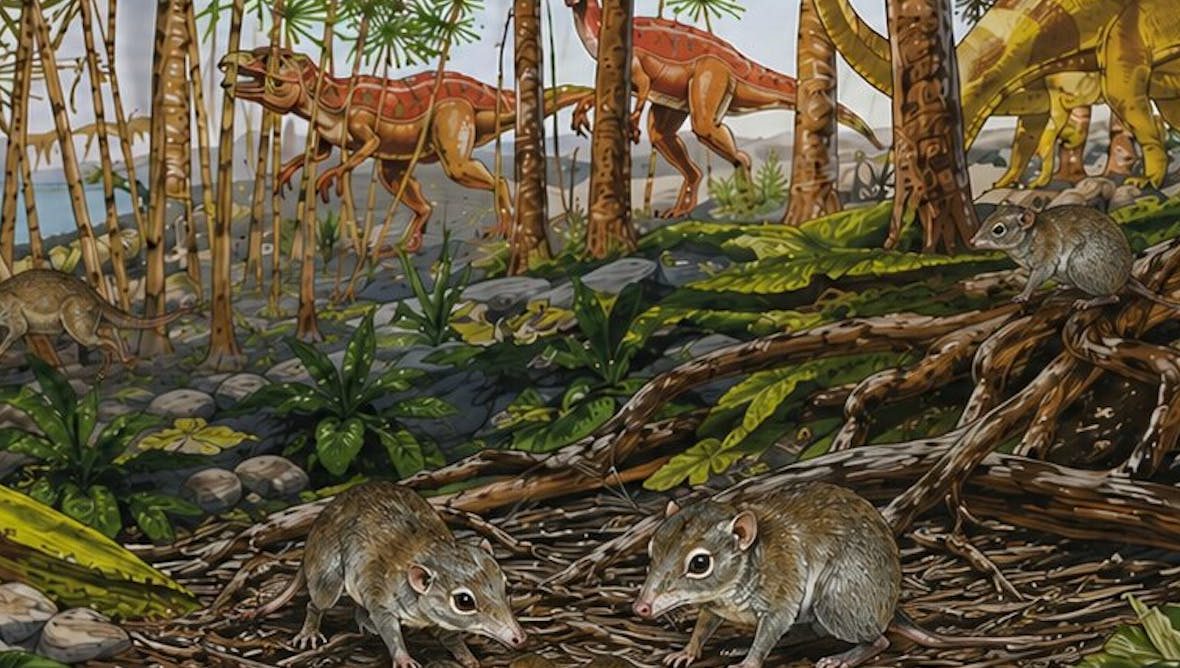
About 200 million years ago, furry little egg-laying creatures evolved the ability to feed their offspring with a secretion from some special glands: milk. Their evolutionary journey continued and by about 160 million years ago, the first mammals with a real placenta had come into being. Instead of laying eggs, they gave birth to live young that had been connected via a placenta directly to their mother during pregnancy, allowing the exchange of oxygen, nutrients and waste products.
These early mammals looked like shrews do today. They were small and had a long body, eyes typical for nocturnal mammals and little spiky teeth for eating insects. But they were not shrews. They were the ancestors of all the placental mammals that exist now, including shrews, bats, elephants and humans.
Wikimedia
While we know quite a lot about what our ancestors looked like and what they ate, so far we didn’t know anything about their social behaviour. Because behaviours don’t fossilise.
Scientists used to think that the first placentals behaved like shrews because they looked like shrews. And as the common belief was that all shrews are solitary, scientists thought the first placental ancestors were too.
Now we know that both assumptions were wrong.
Read more:
Striped mice survive harsh drought by slowing down and not getting stressed
For 10 years I led a group of volunteers, master’s students, PhD students and researchers who conducted a literature survey to better understand the social organisation of wild living mammals – in other words, whether they live as solitary individuals, in pairs or in groups. Together we reviewed more than 15,000 scientific publications.
Using this data for modern mammal species and statistical methods to analyse evolutionary relationships, we could estimate how the first placentals had lived.
Our findings transform the understanding of how our own ancestors lived in the age of the dinosaurs. Rather than being exclusively solitary, they regularly formed stable female-male pairs. Our results also show that early mammals were not locked into one single social system. Like many modern mammals, they showed variation in social organisation.
These findings challenge the traditional image of early mammals as strictly solitary animals, with social behaviour evolving much later. We suggest that the roots of mammalian sociality – and with this some aspects of our own social behaviour – reach much deeper into evolutionary history than previously thought.
Pair-living is common in extant mammals

Carsten Schradin, CC BY
We first studied the shrews and their relatives, and found our first surprise: while around 400 species had been classified as solitary living, only 16 had actually been studied. And most of them at least sometimes lived in groups, 38% in pairs.
If shrews are not solitary but often social, then maybe the early, shrew-like looking ancestors were also more social than we’d believed. No study had tested what the social organisation of early mammals had been. We were able to do this using statistical advances of comparative studies and our new high-quality database.
Our dataset includes data for 806 of the 5,740 extant mammal species, 80 of which are marsupials and 726 placental mammals. Nearly a quarter (24%) are solitary-living, 17% pair-living and more than half (59%) are group-living.
To estimate the social organisation of the ancestor, the evolutionary history of mammals has to be taken into account. Using a statistical model, we were able to do this, by controlling for the fact that some species are closely related to each other.
We found that variation in social organisation within species was common for both extant marsupials and placentals. Their ancestors showed flexibility too. They were not all living solitary lives. Some of them lived in pairs. For placentals, where we had the most data, we found that about one-quarter of the population was pair-living.
In other words: the first placentals, and as such our ancestors living 160 million years ago, sometimes lived in pairs.
Several other studies have shown that the ancestors of major groups of placental mammals living approximately 70 million years ago were predominantly pair-living. That was the case for elephant shrews, even-toed ungulates and primates. This means that from 160 million years ago to 70 million years ago, pair-living transformed from an alternative possibility to the most common form of social organisation in several lines of placentals.
Then about 66 million years ago, the dinosaur era came to an abrupt end. The Earth was struck by an asteroid, and dinosaurs (excepting birds) and most other large animals became extinct. Only small animals survived, including the small mammals which became the ancestors of all today’s mammals.
Read more:
Morocco dinosaur discovery gives clues on why they went extinct
These mammals found themselves in an environment without large predators. This allowed them to become bigger and bigger over the millions of years that followed. And they became more social. Pair-living ancestors gave rise to group-living mammals. The main benefit was protection against predators.
Today most mammals are group-living. They are the only vertebrate taxa where group-living is common.
What’s still missing
Our findings are important because for decades researchers have tried to explain the evolution of pair-living in mammals. But our research shows that this was the wrong question: the hallmark of mammalian social evolution is group-living, while pair-living is an ancient mammalian trait.
Read more:
Who’s got the power? Studies of male and female primates show it’s not simple
Thus, what we need to ask is how mammals became so tolerant and amicable, that several females and several males could live together.




![[WATCH LIVE] Community Meeting, Ebony Park, in Greater Johannesburg Region.](https://www.ebnewsdaily.co.za/wp-content/uploads/2026/09/hqdefault-9-380x240.jpg)