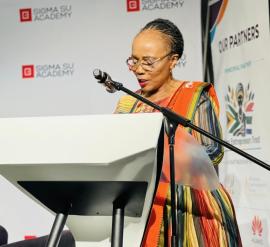
If South Africa is to achieve meaningful economic transformation, women entrepreneurs must be given more access to finance, markets, procurement opportunities and investment, Minister for Women, Youth and Persons with Disabilities Sindisiwe Chikunga said on Friday.
Delivering a keynote address at the Womanpreneur Pitch & Match 2026 at the Johannesburg Stock Exchange (JSE) in Sandton on Friday, Chikunga said women’s economic empowerment remained one of the unfinished tasks of South Africa’s democracy.
“Women’s economic empowerment is not only a matter of social justice; it is a growth and development strategy. The reality, however, is that we have not yet translated this extensive policy and legislative architecture into the scale of economic empowerment required to achieve real justice for women,” Chikunga said.
Chikunga noted that the Womanpreneur Pitch & Match has evolved from a competition into a genuine instrument of economic transformation, connecting women entrepreneurs to capital, markets, investors, and supply chains.
She linked the event to the country’s commemoration of 70 years since the 1956 Women’s March, 50 years since the 1976 Youth Uprisings, and 30 years of the Constitution.
The Minister said the women of 1956 marched for dignity, while the youth of 1976 rose for opportunity, with the Constitution subsequently enshrining dignity, equality, and non-sexism as foundations of democracy.
“Today, our task is to translate those victories into economic inclusion,” Chikunga said.
Chikunga said the country needs to work towards a society where women with viable business ideas can access the capital, markets, networks, and opportunities required to grow.
Strengthening women’s participation in the economy
The Minister highlighted several government interventions aimed at strengthening women’s participation in the economy.
These include, among others, preferential procurement policy, which now requires at least 40% of public procurement opportunities to benefit women-owned and other designated enterprises, while Broad-Based Black Economic Empowerment encourages companies to support women-owned enterprises through supplier and enterprise development.
She also pointed to the Public Procurement Act, signed into law in July 2024, which is being operationalised through draft regulations.
“Government has already trained close to 6 000 women-owned businesses to bid for and win state contracts, and departments are required to monitor and report on women’s participation in every procurement process,” Chikunga said.
The Minister also highlighted the R897 million Imbali For Her blended finance programme, launched by the Department of Small Business Development and the Small Enterprise Development and Finance Agency (SEDFA) in May.
The three-year programme offers up to R5 million per applicant, with grants of 40% for able-bodied women and 50% for women with disabilities. It is expected to support close to 975 women-owned businesses and sustain about 2 250 jobs.
“SEDFA has already disbursed R454 million to women-owned businesses in a single quarter and has reached almost half a million women beneficiaries over the past three years.”
However, Chikunga warned that commitments and approvals are not enough.
“Commitments and approvals are not disbursements, and disbursements are not yet jobs,” she said, calling on development finance institutions and private-sector partners to convert commitments into actual funding for women-owned businesses.
She challenged corporate South Africa to increase procurement spending directed towards women-owned businesses, strengthen supplier development and provide innovative financing and patient capital.
Chikunga also called for women to be supported, not only as suppliers, but as manufacturers, exporters and industrialists.
“The true measure of today’s success will be measured by how many of these businesses have more customers, more capital, more contracts and more employees when we return to this room next year,” she said.
She congratulated the Womanpreneur Alumni Class of 2025 and the Top 10 Finalists of 2026, saying their businesses are already contributing to employment and economic growth.
“Empowered women do not only empower nations, but they also build industries, create jobs, grow economies and change the future,” Chikunga said. – SAnews.gov.za
Source: Original report at SAnews.gov.za.