The recently concluded commemoration of Women’s Month in August, has not closed the door on issues facing women. It remains a reminder of the need to keep the fight against gender-based violence and femicide (GBVF) going.
Sunday, 9 August 2026, marked the 70th anniversary of the Women’s March to the Union Buildings, during which the women demanded an end to discriminatory pass laws.
While South Africa has made significant strides in advancing women’s rights, equality and participation in society, GBVF remains a stark reminder of the unfinished struggle for women’s freedom and dignity.
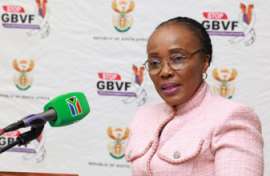
This was the message from Minister in the Presidency for Women, Youth and Persons with Disabilities, Sindisiwe Chikunga, at the inaugural meeting of the National Council on Gender-Based Violence and Femicide (GBVF) Board in Pretoria recently.
The meeting followed the appointment of the Council members by President Cyril Ramaphosa for a period of three years, effective from 1 August 2026 to 31 July 2029.
The operationalisation of the National Council comes in a year that marks two other defining milestones in South Africa’s democratic journey: 50 years since the 1976 Youth Uprising and 30 years since the adoption of the Constitution.
These milestones provide an opportunity to reflect on how far South African women have come since 1956, while acknowledging the challenges that continue to prevent women and girls from fully enjoying the rights secured through decades of struggle.
The 1956 Women’s March, when about 20 000 women from across racial and political backgrounds marched against the extension of pass laws to women, became one of the defining moments in the country’s struggle against apartheid.
Seven decades later, women occupy positions of leadership across government, business, academia, civil society and other sectors of society, while constitutional and legislative reforms have entrenched equality and prohibited discrimination based on gender.
Chikunga said the progress represented by these achievements cannot be separated from the courage and sacrifices of the women who came before.
“Today is not just an inaugural meeting of a Board, but it is the commencement of a constitutional mandate. These milestones remind us that freedom, equality and dignity are not self-executing ideals. They require institutions, leadership and collective action,” she said.
The Minister noted that the establishment of the Council is itself a reflection of how far the country has progressed since the struggles of previous generations.
She said what started as a struggle for basic rights and freedom has evolved into a constitutional commitment to equality, dignity and the protection of all people.
However, Chikunga warned that the continued prevalence of GBVF represents one of the most profound contradictions between the rights guaranteed by the Constitution and the lived experiences of many women and girls.
“The establishment and operationalisation of the National Council on Gender-Based Violence and Femicide is one of many milestones of freedom where South Africa refuses to normalise violence against women and children.”
Chikunga said the creation of the Council is the culmination of years of advocacy and mobilisation by women, civil society, the private sector and academia. These efforts are consolidated through the National Strategic Plan on GBVF and ultimately given effect through an Act of Parliament.
Commitment
The Minister described the Council as more than the creation of another public institution, saying it represented an institutional commitment to addressing a problem that continues to undermine the gains made by women over generations.
“It is the institutional expression of our determination to complete the work of those who marched in 1956, those who rose in 1976, and those who drafted our democratic Constitution.”
The Minister said the 1976 Youth Uprising has also demonstrated the power of young people, including young women, to challenge injustice and demand a different future.
Three decades after the adoption of the Constitution in 1996, South Africa has a strong legal and constitutional framework guaranteeing equality, human dignity and freedom, she said.
Yet, Chikunga said, constitutional rights cannot be considered fully realised if women continue to alter their daily lives because of fear of violence.
“If the lived realities of women, because of gender-based violence, still determine where they can go; what opportunities they can pursue; whether they can participate freely in society, or whether they can live safely, such restrictions mean that, as a society, we have not adhered to the constitutional dictates,” Chikunga explained.
She said GBVF is fundamentally incompatible with the constitutional values of dignity, equality and freedom, adding that the Bill of Rights provides a clear basis for the Council’s existence.
The Minister stressed that the progress made by women over the past 70 years must be protected and advanced by ensuring that violence does not limit their ability to participate fully in society.
She said the goal must be to ensure that women and girls can exercise their rights in practice, rather than merely having those rights guaranteed on paper.
“The work of this Council must always be understood within its constitutional context. This Council exists because the Constitution demands it.”
Cooperation
The Minister said the Council’s success will depend on sustained cooperation across society, including government, civil society, labour, business, faith-based organisations, traditional leaders and communities.
South Africa, she said, now has the evidence, legislation and institutional mandate required to strengthen its response to GBVF.
The responsibility now rests with the newly established Council to help translate the hard-won gains of generations of women into lived realities, ensuring that freedom, equality, dignity and safety are enjoyed by every woman and girl in South Africa.
For Chikunga, the 70-year journey from the Women’s March of 1956 to the present is both a celebration of progress and a call to complete the work that remains.
The women who marched in 1956 challenged a system that sought to restrict their freedom. Seven decades later, the struggle has taken a different form — ensuring that the freedoms and rights secured through that struggle are not undermined by violence, fear and inequality.
In terms of section 6(6)(a) of the National Council on Gender-Based Violence and Femicide Act, the President designated Dr Ramalepe Lebogang Mathibe as the Chairperson of the Council and Welheminah R. (Shoki) Tshabalala as the Deputy Chairperson.
The end of Women’s Month does not mean that the fight against GBVF should end. Communities can play their part by encouraging victims to seek help from the police and informing them about shelters and other support services that can help them rebuild their lives. – SAnews.gov.za
Source: Original report at SAnews.gov.za.