Science becomes easier to question when you can move beyond a textbook: compare an experiment with your prediction, discuss a demonstration or connect a night-sky presentation with what you can observe outside. South Africa has several kinds of places for doing that, from university resource centres to museum collections and observatory programmes.
How we selected these 10
This is an editorial shortlist, not a measured ranking. We selected ten distinct venues with identifiable institutional providers and publicly available information about science learning, facilities or visitor arrangements. The order groups related experiences rather than awarding scores. Provider pages were checked on 7 and 8 November 2026. We did not visit the venues, test booking systems or confirm individual sessions by telephone. Inclusion does not establish accreditation, current admission availability or educational outcomes. Prices are omitted; confirm the current programme, cost and access before travelling. This is a planning guide for families, learners and educators, and some entries are better approached through an organised group than a casual visit.
1. Sci-Bono Discovery Centre: explore through interaction
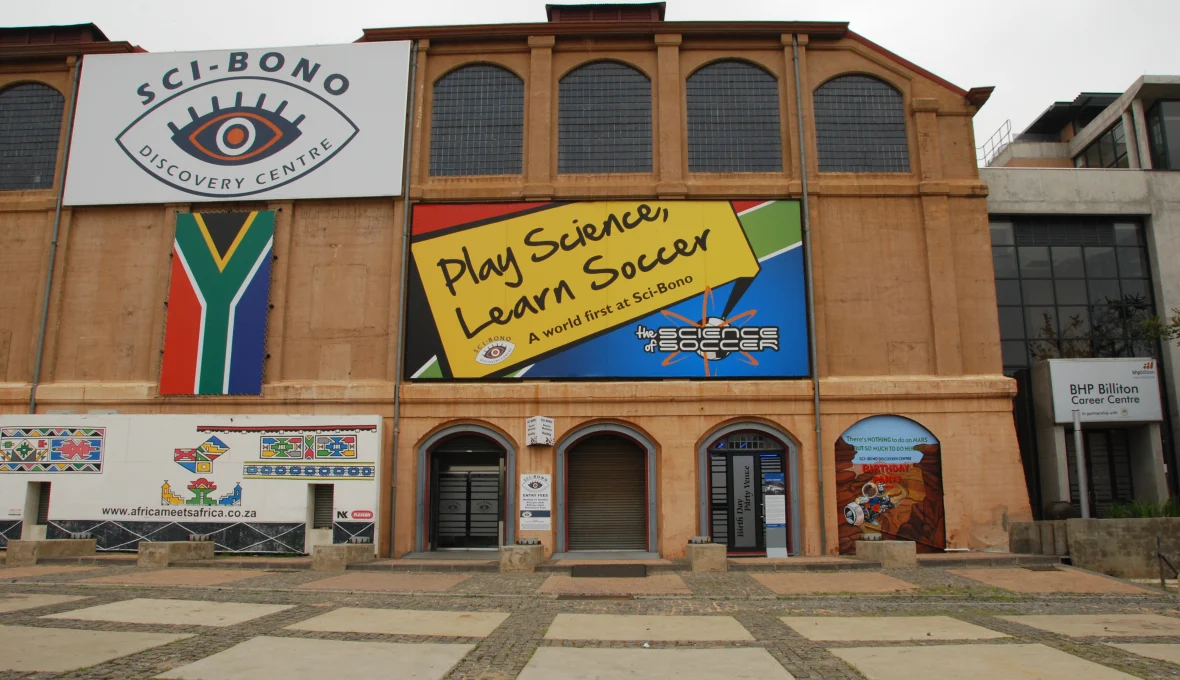
Sci-Bono in Johannesburg’s Newtown area is a starting point for people who want to engage with exhibits rather than only read labels. Its official exhibit page describes interactive permanent displays and a programme of temporary, travelling and mobile exhibitions. The broad focus spans science, mathematics, engineering and technology. That variety makes it sensible to choose a few questions before arriving instead of trying to complete every display. For example, ask what changes when you alter one part of an exhibit and how you would explain the result to someone else. Check which exhibitions are currently available; an example listed on a website or an old photograph does not establish today’s programme. School organisers should use the centre’s published booking contacts and discuss group needs. Best for: an exhibit-led introduction to scientific ideas. Official exhibit information.
2. Cape Town Science Centre: plan a group-friendly visit
The Cape Town Science Centre’s visitor page provides a practical starting point for planning a science outing in Observatory. It identifies its location on Main Road and supplies information for individuals, families and organised groups. Group visits require advance booking to qualify for the published group arrangements. The current page lists Sunday closure and warns that additional closures can occur, so do not assume that a weekend trip will always be possible. Start by establishing who is coming, their ages and the amount of time available, then ask the centre about the appropriate programme. Check what a ticket includes before adding any optional activities. An outing works better when the group has time to discuss what interested them afterwards, rather than treating the visit as another assessment. Best for: families or educators who want to organise a visit through a clear official visitor-information page. Plan through the centre.
3. UNIZULU Science Centre: combine exhibits and discussion
The University of Zululand’s Science Centre describes an Exploratorium with interactive experiments, science shows, workshops and career-guidance activities. Its programmes also include an inflatable planetarium and outreach work, giving educators several possible ways to connect a visit with classroom learning. Those are programme categories, not a promise that every component will run for every group. The centre’s current school-visit information stresses planning an experience that allows time for the activities rather than rushing between them. Discuss learners’ grades, the scientific topics they are studying and any particular practical requirements when booking. A teacher might choose one concept for pupils to explain afterwards, while allowing room for questions outside the syllabus. Confirm the available show, group arrangements and accessibility directly. Best for: organised learner groups seeking a combination of demonstrations, exhibits and science-related career discussion. Explore UNIZULU’s programme.
4. Vuwani Science Resource Centre: connect learning with practical support
The University of Venda’s Vuwani Science Resource Centre places science learning within a wider community-support role. Its official description identifies physics, chemistry, biology and computer-literacy laboratories, alongside school visits, laboratory instruction, revision, career guidance and mobile laboratory activities. This is especially relevant to educators looking for practical support rather than simply a leisure attraction. The university also lists extended-learning and teacher-development activities. Contact the centre through its official university information to establish which programmes are available for your group and where the activity will take place. Do not assume that a general facilities list guarantees an unscheduled public laboratory session. Prepare a focused question about the learners’ needs and the resources their school already has. Best for: schools and community participants exploring structured science, mathematics or digital-learning support in Limpopo. Read the university’s centre profile.
5. NWU Science Centre, Potchefstroom: look behind experimental apparatus
North-West University describes its Potchefstroom Science Centre as both a science-engagement venue and a base for developing experimental apparatus. Its history explains how equipment produced there has reached other science centres, making the institution interesting for educators who want to think about how demonstrations are designed. The official contact page places the Potchefstroom centre in Building F24. Confirm the correct campus when making an enquiry: NWU also has a separate science centre in Mahikeng, and arrangements should not be transferred from one location to the other. Ask about the current programme, the audience it serves and whether a facilitated group visit is appropriate. A useful discussion can start with the distinction between observing a result and explaining why it happened. Best for: planning a university-linked science-learning enquiry in North West. Centre background and official contact details.
6. ArcelorMittal Science Centre, Sebokeng: consider curriculum support
The Sebokeng centre in Gauteng’s Vaal Triangle is described by its provider as a facility for hands-on science learning, with classrooms, laboratories, computer facilities and interactive science activities. Its purpose extends beyond a single exhibition visit to supporting learners and educators. That makes it worth investigating when a school needs a more structured link between classroom concepts and practical work. Begin with the official facility page and explain the grade, subject and learning objective when contacting the centre. Ask which activities can be arranged and what preparation teachers should complete beforehand. Do not read a provider’s description of facilities as a guarantee that every room or programme is available on a chosen day. Keep the learning goal specific enough that pupils can revisit it after the session. Best for: school-led enquiries about science and mathematics support in the Sebokeng area. Official Gauteng facility information.
7. ArcelorMittal Science Centre, Saldanha: check the exact destination
ArcelorMittal’s science-centre network includes a Saldanha centre, with its official contact directory listing a physical address at Esperanza Hostel in Vredenburg. That naming distinction matters when arranging transport: confirm the actual meeting point rather than navigating only by the centre’s name. The network’s stated focus includes science and mathematics learning, practical facilities and support for educators and learners. Use that as a basis for an enquiry, not as a timetable for an unannounced visit. Ask the centre which activities are currently offered, who can participate and whether a school or community group needs to book a dedicated session. If the group is working on a particular topic, share it in advance so that the visit can be matched to an appropriate activity where available. Best for: West Coast organisations investigating a local science-learning partnership. Official network contacts.
8. Iziko Planetarium and Digital Dome: connect a presentation with the sky
Iziko’s Planetarium and Digital Dome in Cape Town offers a different kind of science encounter: a scheduled presentation rather than an unrestricted circuit of exhibits. The institution’s education page lists programmes and resources for school groups and other audiences, including sky maps. A useful approach is to choose a show suited to the group’s age and interests, then use the relevant monthly map to revisit the subject later. A digital sky presentation should not be confused with looking through an outdoor telescope, and images can show detail that is not visible to the unaided eye. Check the actual show schedule, access arrangements and applicable ticket conditions on Iziko’s official pages before travelling. Do not assume a museum ticket includes the planetarium. Best for: a structured introduction to astronomy with opportunities for follow-up learning. Planetarium education and resources.
9. SAAO, Cape Town: understand an observatory visit’s limits
The South African Astronomical Observatory’s Cape Town visitor programme combines astronomy presentations with access to parts of its historic Observatory site. Its official page describes open nights and night tours, with stargazing dependent on weather. It also states that the McClean telescope and dome are undergoing maintenance and are unavailable to the public, although the museum remains accessible. That limitation is important when deciding what experience to expect. Book through the official programme and check what is included on your chosen date; this is a secure working site, not an invitation to enter other buildings independently. The provider recommends warm clothing and suitable footwear because visitors move between locations. Its open-night audience guidance is aimed at ages 12 and older. Best for: people interested in the work and heritage of astronomy who can plan around a scheduled visit. Official Cape Town visitor information.
10. Iziko South African Museum: ask questions of natural-history collections
The Iziko South African Museum in Cape Town’s Company’s Garden offers a collection-based route into science. Iziko describes natural-history material ranging from fossils to insects, alongside other historical collections. Here the useful habit is to look closely at an object and ask what evidence it provides, how it was interpreted and what further questions remain. This differs from a science-centre visit built around manipulating an exhibit: both approaches can be valuable without being interchangeable. A school organiser should distinguish a booked lesson with a museum educator from an independent group visit, because the arrangements and experience differ. Check the museum’s current admission and education information rather than borrowing the planetarium’s conditions. Leave time to compare observations after the visit instead of trying to read every label in one pass. Best for: learners and families who want to explore natural history through collections. Iziko visitor and education information.
At a glance
| Place | Starting point | Check first |
|---|---|---|
| Sci-Bono | Interactive exhibits | Current exhibitions and group booking |
| Cape Town Science Centre | Family or group outing | Closure notices and group arrangements |
| UNIZULU Science Centre | Shows, exhibits and school activities | Grade and programme suitability |
| Vuwani Science Resource Centre | Laboratory and learning support | Programme, venue and eligibility |
| NWU Potchefstroom | University-linked science learning | Correct campus and arranged access |
| ArcelorMittal Sebokeng | Curriculum-related science support | Available sessions and preparation |
| ArcelorMittal Saldanha | West Coast science-learning enquiry | Vredenburg meeting point |
| Iziko Planetarium | Astronomy presentations | Show times and separate admission |
| SAAO Cape Town | Observatory programme | Booking, maintenance and weather |
| South African Museum | Natural-history collections | Independent visit versus booked lesson |
Before you choose
Start with the audience and the question you want to explore. A young family, a matric class and a teacher-development group may need very different programmes. Ask about booking, age suitability, language, accessibility, supervision, transport access and the facilities actually included. University and educational resource centres should not be assumed to accept walk-in visitors. Confirm the total cost directly and distinguish general entry from facilitated lessons, special exhibitions or planetarium shows. None of these entries promises better marks, a qualification or access to a research laboratory. Follow staff instructions around equipment and do not turn a demonstration into an unsupervised experiment at home.
Sources and updates
Official provider information was checked on 7 and 8 November 2026, with source links included beside each entry. This is desk research, not a firsthand review, accreditation audit or endorsement by the institutions. Individual programmes and booking functions were not tested. Some provider pages contain historical material; past festivals, exhibits and promotional prices are not presented here as current offers. Confirm the programme close to your visit.
Cover photograph: Sci-Bono Discovery Centre in Johannesburg, photographed on 16 January 2011. Archive exterior, not a depiction of today’s exhibitions or admission offers; visible promotional signs are historical. Photo: Ossewa / Wikimedia Commons. Source: https://commons.wikimedia.org/wiki/File:Sci-Bono_Discovery_Centre_01.jpg . Licence: CC BY 4.0, https://creativecommons.org/licenses/by/4.0/ . Cropped and resized for display.