Ndodana Mkhanyisi Tshuma left Britain in early July, days before the bodies of his wife and two daughters were found at their home near Bedford. Within a week, he was in South African custody. Nearly four months later, two separate court processes help explain why he remains there.
British prosecutors have authorised three murder charges against Tshuma, also known as Mark, over the deaths of Nothabo Zandile Tshuma, 42, known as Zandile, and their daughters Natalie, 15, and Nala, five. He has not been convicted of those murders. A separate South African case concerns firearms, ammunition and immigration offences.
Here is what is known about his departure, arrest and the proceedings that followed.
The discovery in Great Denham
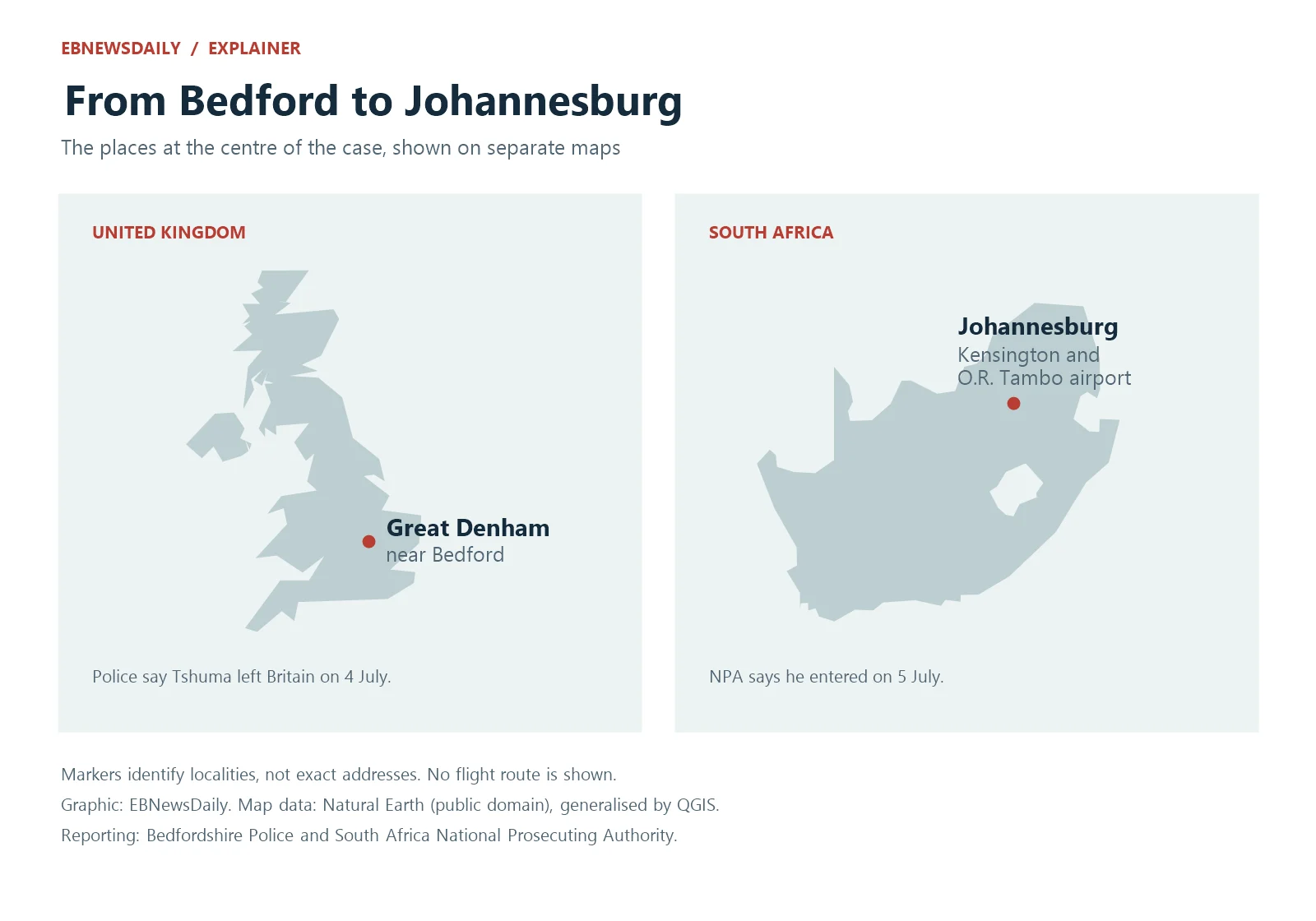
On 7 July 2026, Zandile, Natalie and Nala were found dead at their home in Great Denham, a village on the western edge of Bedford, north of London, according to the Crown Prosecution Service (CPS). A murder investigation was launched by the Bedfordshire, Cambridgeshire and Hertfordshire Major Crime Unit.
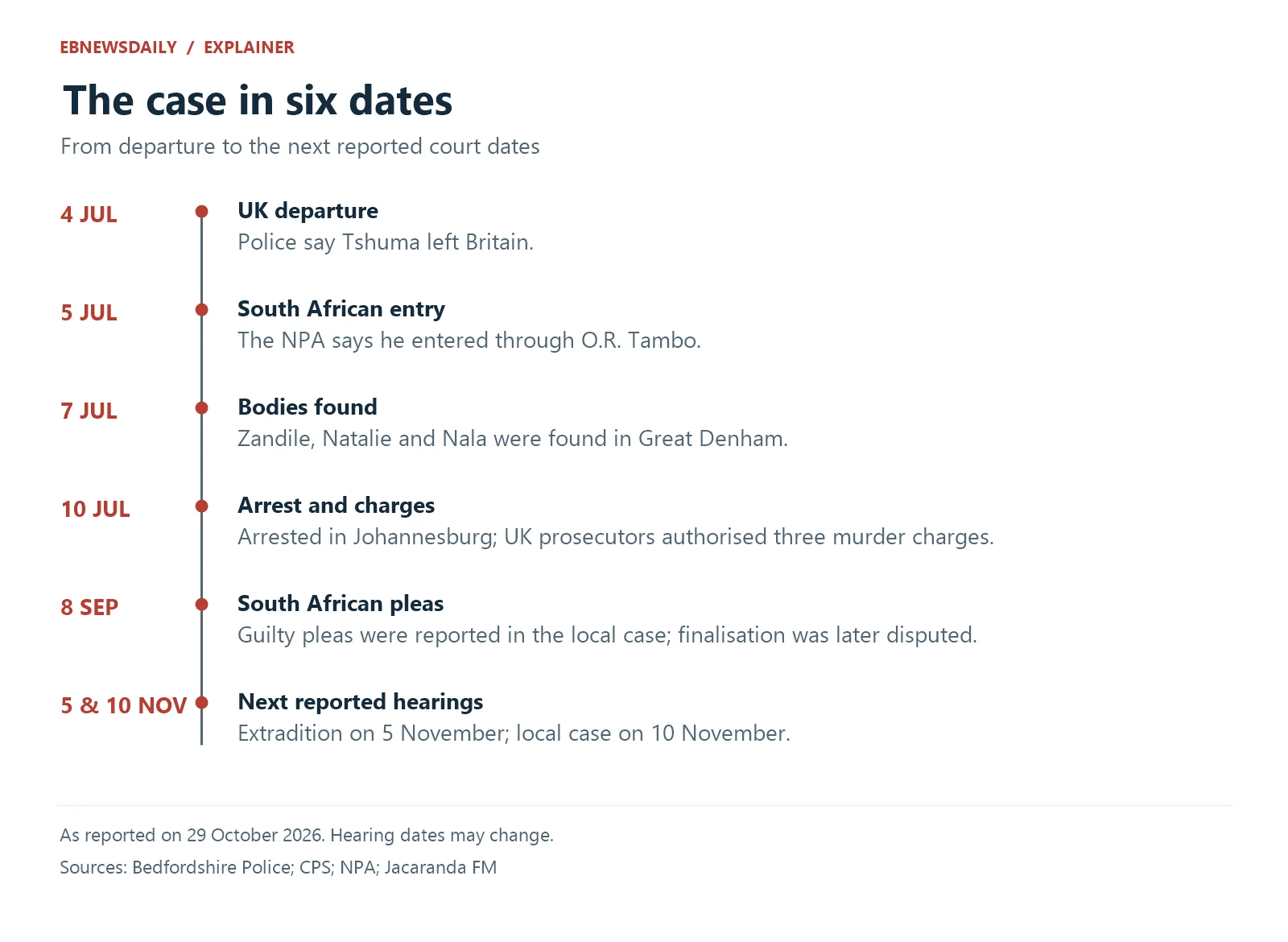
Police said Tshuma, a British citizen of Zimbabwean heritage, left Britain on 4 July and believed he had departed through Heathrow using a British passport. He was already outside the country when the bodies were found. The force appealed for information as it worked with international partners to find him. Read the original police appeal.
How did he reach South Africa?
South Africa’s National Prosecuting Authority (NPA) says Tshuma entered the country lawfully through O.R. Tambo International Airport on 5 July. British police initially believed he had travelled to Zimbabwe and later said they believed he had come to South Africa from there. Those statements do not establish a complete flight itinerary; the available public accounts do not confirm every stop.
By 10 July, South African police had arrested Tshuma in Kensington, Johannesburg. The NPA has described international coordination through INTERPOL and a Westminster Magistrates’ Court warrant. Bedfordshire Police said the operation involved the UK National Crime Agency and authorities in Zimbabwe and South Africa. The force said Tshuma was remanded in custody while work began to seek his return to Britain.
On the day of the arrest, the CPS authorised three murder charges.
Why is he still in custody in South Africa?
The British murder case is only one part of the picture. Tshuma also faces a South African criminal case involving a firearm, ammunition and an immigration offence. Those are local proceedings, separate from the UK murder charges and from the extradition process.
On 8 September, Jacaranda FM reported that Tshuma had pleaded guilty to four charges under a proposed plea-and-sentence agreement. The agreement was not then finalised.
By 29 October, its finalisation was in dispute. Tshuma’s lawyer told the Johannesburg Magistrate’s Court that his client could not remember pleading guilty or signing the agreement and asked for a specialist assessment. Prosecutors argued that there was no evidence at that stage to justify an assessment and sought to finalise the agreement, Jacaranda FM reported. The court postponed the local matter to 10 November.
He has been held in custody while the South African matters proceed. The public reports reviewed do not establish a final sentence in the local case or identify a specific prison, so neither should be assumed.
What happens next?
Extradition is the legal process through which the UK seeks Tshuma’s return from South Africa. It is distinct from deciding the murder charges themselves. The extradition matter was next listed for 5 November, while the local case was postponed to 10 November, according to the 29 October court report.
Neither a final extradition order nor a completed transfer to the UK had been verified in the reporting available for this article. The court dates and status may change as the proceedings continue.
Reporting reflects information available on 1 November 2026.
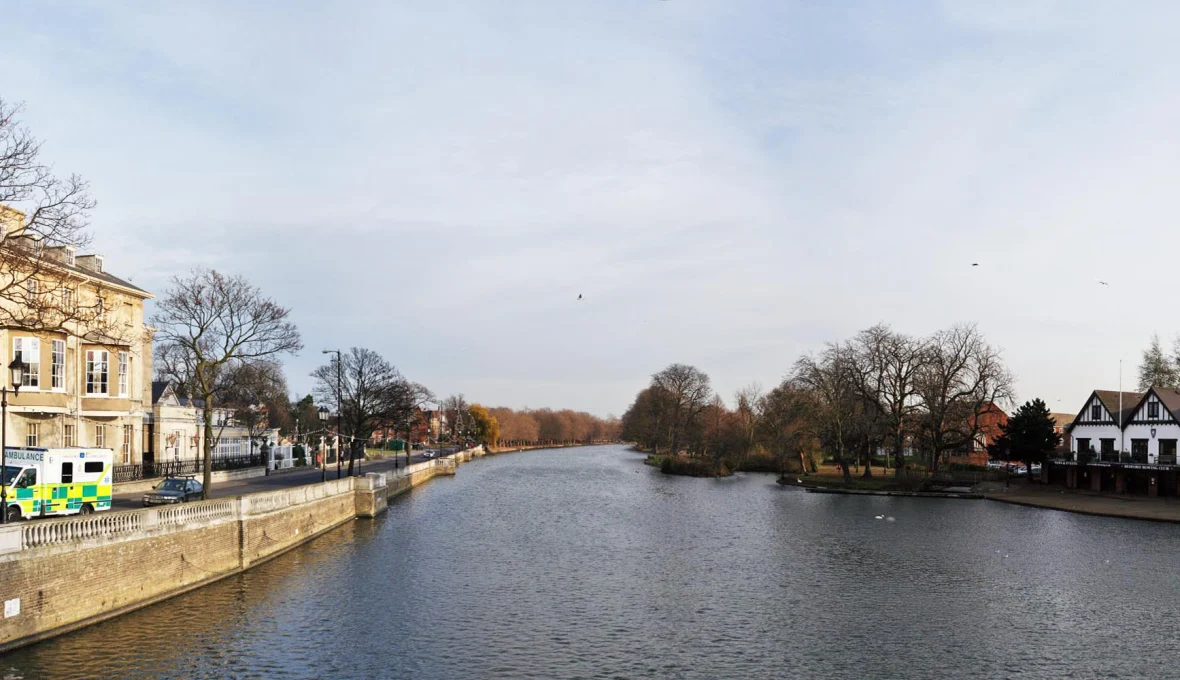
Featured image: archive view of the River Great Ouse in Bedford from Town Bridge; it does not show the family home. Photograph by Petesmiles at English Wikipedia, via Wikimedia Commons, CC BY-SA 3.0. Resized and converted for display.