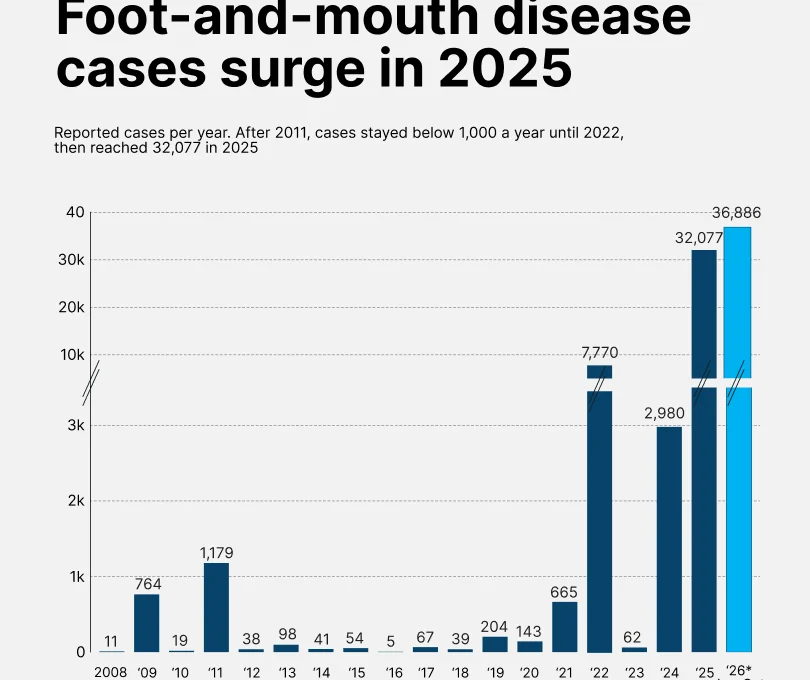
South Africa is experiencing its worst foot-and-mouth disease (FMD) epidemic. Farmers have described the huge financial losses as well as hardship for workers and animals when their farms have had outbreaks.
In 2019 the World Organisation for Animal Health (WOAH) withdrew the FMD-free status that most of the country enjoyed. Consequently, our cattle product export markets were badly hit.
This week’s chart shows how FMD cases have surged in recent years, from below 100 a year from 2014 to 2018 (confined to an area near the Kruger National Park), to 32,000 in 2025 across the country. But we are sceptical of these statistics.
There are about 12 to 14-million cattle in the country. If less than 0.3% of them had been infected last year (which is what the stats show), this would be a much less serious epidemic than it has been. The statistics have been underestimated for a few reasons. 
First, the Department of Agriculture and the Agricultural Research Council have not led a coordinated response to the epidemic, including providing one properly working central dashboard of reliable statistics. Instead, industry bodies, like the Milk Producers Organisation, the Red Meat Industry Services and a company called Buffalo Analytics, sometimes in coordination with provincial agricultural departments, have filled the void, doing their best to provide coherent statistics on aspects of the epidemic.
Instead a scathing government-commissioned report in 2022 found a lack of leadership, management and trust across South Africa’s agricultural animal sector. The few months we have been covering the epidemic have confirmed this. There’s also been a hefty dose of state corruption.
Second, some farmers understate or don’t report their outbreaks. Facing the threat of quarantine if they have FMD outbreaks, some will simply deal with the disease themselves rather than co-operate with the state.
While the disease hits dairy farms especially hard (sick cows struggle to produce milk), some beef farmers can sometimes sit it out, try to steer their sick animals through the outbreak and accept the loss of a small portion of their herds.
Also, many small-scale farmers, whose animals constitute about half the national stock, are operating in informal environments where proper monitoring and record-keeping is especially hard.
Third, we suspect that what in practice eventually gets counted as a “case” is very conservative. Even where farmers do report outbreaks, authorities will often only count an animal as an FMD case if it has a positive laboratory test, despite the animal having FMD symptoms. Only a fraction of sick animals get tested.
Reliable statistics are important. They allow the epidemic to be better monitored and modelled, and preventative action to be taken. They also provide vital information that the government can use to negotiate with WOAH and others so that one day our FMD-free status can be reinstated.
Consider this table:
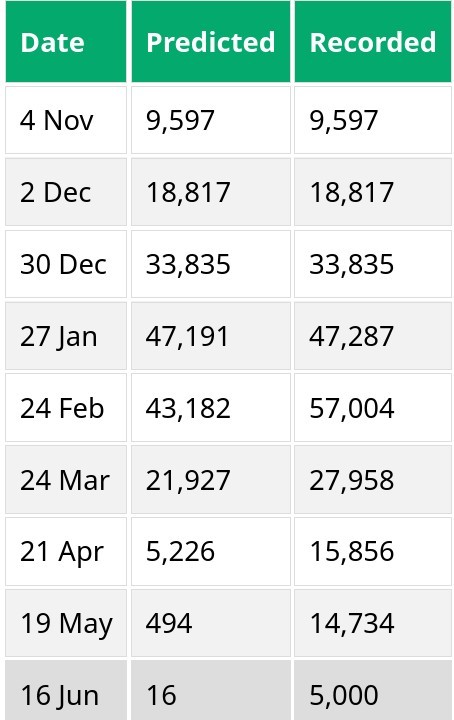
The 5,000 number in the third column of the last row is an estimate; the remaining entries in the third column are recorded cases. Source: Modelling infectious diseases and BMJ
The first column is the date. The third column (except for the very last row, which is approximate) is the recorded number of sick cows during the English cattle plague of 1865-1866 (caused by the rinderpest virus). The second column is an estimate from a famous model of the epidemic by William Farr. It gave rise to our modern mathematics of epidemiology. But this was only possible because the English government kept such good records of the plague. 150 years later in South Africa, despite much better technology, we don’t do as good a job.
It’s not all bad news though. Vaccination has been widely rolled out. As we reported last month, it is even reaching remote villages in Limpopo (see A brilliant example of the state succeeding). Nearly all dairy cows have been vaccinated, most of them twice. But even so, the vaccination stats lack central coordination.
The Department of Agriculture should have set up a properly working FMD dashboard that is updated at least weekly with a range of statistics and maps. A good example is this one by the Western Cape department. (Part of the problem, we have been told, is that the nine provincial agriculture departments are of vastly varying competence and difficult to coordinate.)
It appears the epidemic is receding. This is likely due to a combination of factors: mass vaccination (millions of doses have been administered but we can’t get a reliable consolidated statistic), an improvement in control of animal movement and the natural waxing and waning of epidemics.
But FMD is endemic to South Africa’s buffalo population; there is no prospect of eradicating it without a fantastic technological advance. Until 2019, the state tried to keep the disease at bay by confining monitoring for the disease and conservative use of vaccines to a zone around the Kruger National Park. This failed dramatically. Even when this failure was apparent to farmers, the agriculture department continued to be shy about allowing widespread use of vaccines, resulting in an acrimonious court case and ultimately the agriculture minister, Johan Steenhuisen, losing his job in July.
Thankfully the government’s approach to vaccines has changed. The new minister, Willie Aucamp, has shown more leadership. But if we don’t keep up the vaccination programme – meaning two doses per year in nearly every bovine, and possibly other cloven-hoofed animals – the epidemic will likely surge again. For now, we are a long way off from regaining WOAH FMD-free status.
© 2026 GroundUp. This article is published under the GroundUp Republication Licence Version 1.0. Email [email protected] to request permission to republish.