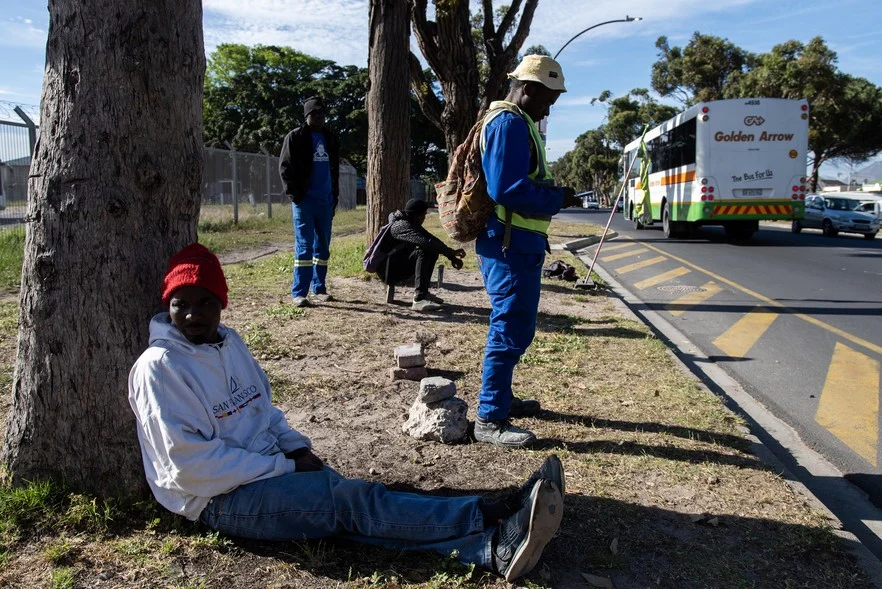
Day after day, a group of men, some skilled in painting, welding or landscaping, wait on the side of Rosmead Avenue in Wynberg, Cape Town hoping to be offered work for the day, 20 October 2026. The men told GroundUp they often wait for days before getting any work and many arrive hungry. Photos: David Harrison
Along the busy Rosmead Avenue in Wynberg, Cape Town, day-after-day dozens of men stand in groups. Most are from Malawi or Zimbabwe. They are painters, tilers, plumbers, joiners, electricians, welders, tree-fellers, landscapers, some with the tools of their trade. They are hoping for work.
They live areas like Philippi, Gugulethu and Hout Bay, or as far away as Somerset West. Every day they all make their way walking or by taxi to their spots along the road. There they wait for hours, watching for any bakkie or truck in the traffic, ready to run if they think someone might be about to stop and offer some work.
Sometimes they wait for days or weeks without work, they told GroundUp. When they do get work, they might get as little as R200 or as much as R700 for the day. Some employers don’t pay at all at the end of the day.

When this bakkie stopped, the men all rushed to it. The men have different skills from painting, plumbing, welding, tiling, but will always do whatever work is on offer and mostly at rates as little as R200 for the day.
Sometimes the work is not safe and no protective equipment is provided. Sometimes men with chainsaws or other equipment have been picked up for work only to be robbed at gunpoint and tossed out of the vehicle. 
Sometimes residents or members of religious groups come to offer the men a cup of coffee or a sandwich. Sometimes they don’t eat at all for days, they told GroundUp.
Danken Marinde from Malawi lives in Philippi. Mainde told GroundUp he had training and work experience with some large construction companies. Now he has a small household repair business offering plumbing, decking, painting and waterproofing.

Danken Marinde from Malawi says he has worked for large construction companies, where he was trained as a painter and plumber. He advertises his services by dropping flyers around the suburbs and at markets. When he has no other work, he walks for an hour and a half from Philippi where he stays to Rosmead Avenue to wait for a passerby to offer him a job for the day.
He drops flyers around residential neighborhoods and if he doesn’t have any work, then he heads to Rosmead Avenue to see if he’ll get lucky for the day.
“I must walk here from Philippi,” he says. “It takes about one and a half hours. If I don’t get work, then I won’t have money for a taxi (R25) and so I must walk home at the end of the day.”
Asked about his experience being from Malawi living in a South African township, Danken told GroundUp he had not been targeted during the recent wave of xenophobia.
“We are blessed to live in Cape Town, it’s better here. People say we are taking locals’ jobs, but I don’t see any South Africans standing here for work. Whose jobs are we taking?”

This equipment belongs to a qualified welder named Alex from Zimbabwe. Alex told GroundUp he can make up to R700 a day but often has to wait for over two weeks to get any work.
Taku (not his real name) originally from Mbare in Zimbabwe lives in Guguletu with his wife and young children. He has been coming to Rosmead Avenue to get work since 2017.
“There’s no opportunity in Zimbabwe, too many people have nothing.”
Taku showed off some of his landscaping equipment tied together on the side of the road. “If work comes, we have guys for anything. Whatever comes we make a plan.”
Many of the men left Rosmead Avenue for a while at the height of the March and March protests, says Taku. “Some came back because they need to survive. No one wanted to stop to pick us up, they were scared to get a fine, but we still had to come here because we had to eat.”

Albert Makesha sells furniture and screens made from wooden sticks. He sells the drawers from R450 and screens from R550.
Albert Makesha sells furniture and screens. Makesha, who arrived from Zimbabwe this year leaving his family behind, lives in Somerset West with six other Zimbabweans.
The men work together to make the furniture they sell on the side of the road, wooden drawers from R450 and screens from R550. He’s there seven days a week, weather permitting, though some days they make very few sales.

Many of the people we spoke to wait with their equipment hoping it will give them an advantage to be offered work.
“I need to be here all the time. I can’t take a break. Sometimes we only sell once a week, sometimes nothing. The material is expensive; we have to rent a truck and drive to George every two months to get the sticks,” he says.
Makesha says work has fallen off for all the men since the March and March protests. “There were more guys and before they were getting work. Nowadays they are not getting work. You can come here every day and you see them just standing. So now in South Africa we are just surviving. It’s better to go home, but we don’t have money.”

The men gathered around a bakkie as a local resident drops off cups of coffee and sandwiches for them.
© 2026 GroundUp. This article is published under the GroundUp Republication Licence Version 1.0. Email [email protected] to request permission to republish.